
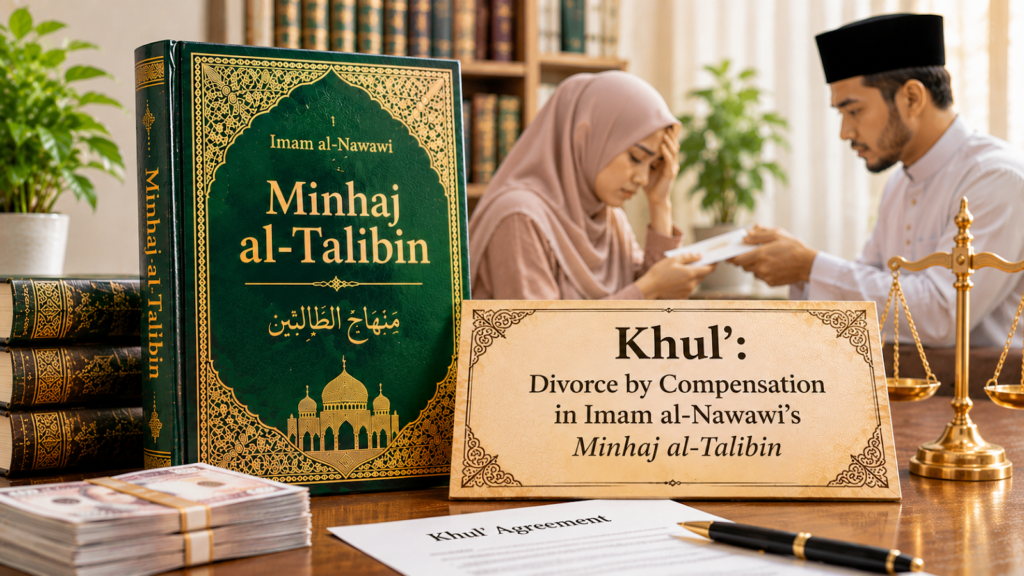
Khul’: Divorce by Compensation in Imam al-Nawawi’s Minhaj al-Talibin
Part 3: Family Law (Munakahat) – Divorce by compensation (Khul’)
Part of a series on the structure of Minhaj al-Talibin, the classical Shafi’i legal manual. Section 2 of Part 3 (Family Law).
Introduction
After the Book of Marriage, Imam al-Nawawi (631–676 AH / 1233–1277 CE) presents the Book of Divorce by Compensation (Kitab al-Khul’). The word khul’ comes from a root meaning to remove or take off, and the usual explanation is that the spouses are described in the Qur’an as garments for one another, so that ending the marriage is like removing the garment. In the legal sense, it refers to a separation in which the wife, or someone on her behalf, gives the husband compensation in exchange for ending the marriage.
The book belongs here, directly after marriage, because it deals with the first way in which a marriage may end. The distinguishing feature of this form of separation is that it is based on agreement and payment, usually initiated by a wife who wishes to leave the marriage. The Qur’an addresses the matter in the chapter of the Cow, which says that there is no blame on the spouses for what the wife gives to free herself. The tradition also records the case of the wife of Thabit ibn Qays, who came to the Prophet and said that she did not fault her husband in religion or character, but that she disliked living with him. The Prophet asked her whether she would return the garden her husband had given her, and when she agreed, he told the husband to take it and to separate from her. This article follows the main themes of the book in the general order of the Minhaj.
1. The ruling on khul’
The school holds that khul’ is permitted, but disliked, unless there is a need for it. The need may arise if the wife fears that she will be unable to fulfill her duties toward her husband or to live within the limits of God, or if she is exposed to harm. It may become recommended or even obligatory in some cases, such as when the husband is neglecting an obligation of religion and the wife’s staying would involve her in it. The book also states that a husband is forbidden to mistreat his wife in order to pressure her into paying for her release, based on the Qur’anic prohibition of treating wives harshly in order to take back part of what was given to them.
2. The pillars of khul’
The school lists the elements as the wording, the husband, the wife, and the compensation.
- The wording: expressions that indicate the separation in return for compensation. A statement using the word khul’ itself, such as “I release you in exchange for such an amount,” is a clear form. Other words, such as “I divorce you for such an amount,” also work. The wife or her agent accepts. If the wording does not mention the compensation, the school discusses whether the statement is a khul’ or a simple divorce, and holds that the intention of the speaker and the context determine it.
- The husband: he must be capable of divorcing, which means mature, sane, and acting by choice.
- The wife: she must be a wife in a valid marriage, and capable of entering a financial agreement. A wife who is a minor, or who is under restriction because of poor financial judgment, cannot validly agree to pay, and the school explains who acts for her.
- The compensation (‘iwad): the property that the wife pays, which must be something that can be owned and has lawful value.
3. The compensation
The compensation may be anything of lawful value, such as money, goods, or the waiver of a right. The school permits the amount to be equal to the dowry, or less, or more, since it is a matter of agreement. It is disliked, however, for the husband to take more than he gave, since the Qur’an speaks of what the wife gives to free herself in a spirit of fairness. If the compensation is defective, for instance if it is unlawful or unknown, the khul’ still takes effect, in the school’s position, but the wife owes the husband a sum equal to the customary dowry of women of her standing, not the thing that was named.
The compensation may be paid by someone other than the wife, such as her father or a third party, who offers it on her behalf. In this case the school treats the payer as a party to the agreement, and the rules for the payment apply to him.
4. The legal nature of khul’
A major question that the book addresses is how to classify the separation. Is it a form of divorce, counted among the husband’s three divorces, or is it a dissolution of the contract that does not reduce that number? The Shafi’i school discusses both views. In the position that the Minhaj relies upon, it is treated as a divorce, and counts toward the number of divorces that the husband holds. The practical consequence is that a husband who has already divorced his wife twice and then performs a khul’ has used his third divorce, and she is no longer lawful for him until she has been married to another man.
5. The effects of khul’

The separation by khul’ is irrevocable. The husband has no right to take his wife back during her waiting period, since she has paid for her release. If they wish to reunite, they must conclude a new marriage with her consent, a new dowry, and the usual formalities. During the waiting period, she remains in the marital home or a suitable residence, according to the rules for the waiting period, which appear in a later book. The husband is not required to provide maintenance to a wife who has been separated by khul’, except if she is pregnant, as the school explains. Because the separation is final, the spouses no longer inherit from one another if one dies afterwards.
The book notes that khul’ may take place before or after consummation, and that it has no effect on the husband’s duty to pay the dowry unless the agreement provides otherwise, since the compensation may be set against it.
6. Conditions and special cases
The school discusses several special situations. If the husband says to his wife that he will release her if she pays, and she says that she has paid, the question is whether the contract is concluded. If the husband grants a khul’ without compensation, or the wife fails to pay what she promised, the school applies its rules on the effect of these omissions. A husband may appoint an agent to conclude the khul’ on his behalf, and a wife may do the same. The book also discusses the case of a wife who pays a sum and then claims that the husband forced her, and notes that the burden of proof is on her.
7. Disputes
The last part of the book treats disagreements between the spouses. They may disagree about whether there was a khul’ or only a simple divorce, about the amount of compensation, or about whether it has been paid. The school applies the rules of evidence and oath, with particular attention to the question of who is believed in each case. The statement of the husband is usually accepted regarding whether he intended a divorce by his words, since he is the one who knows his intention, while the question of the amount is resolved by mutual oaths.
Why the order matters
The book begins with the ruling and the basis in the sources, then explains the elements of the contract, and then the compensation, the nature of the separation, and its consequences. It ends with special cases and disputes. This order lets the student see the reasoning behind the institution: it is a concession that allows a wife who wishes to leave to do so at a cost, balancing her interest in ending an unwanted marriage with the husband’s right to be compensated for the commitment he undertook.
Closing reflection
For al-Nawawi, khul’ reflects the law’s recognition that a marriage cannot be sustained by compulsion. It gives a wife a lawful way out, even when the husband has not wronged her, and in doing so it protects her from being trapped in a marriage she cannot bear. The restrictions against mistreating a wife to force payment, and the preference for moderation in the amount, show that the law is equally concerned with fairness. The tradition’s report of the wife of Thabit, who asked for release on account of dislike alone, captures the moral tone: separation is permitted, but it should be undertaken with care and kindness.
Note: This article summarizes the general Shafi’i position as presented in Minhaj al-Talibin. Details, including the classification of khul’ as a divorce, differ among the schools and can vary between editions and commentaries. Divorce is also regulated by national laws, so readers who need a precise ruling should consult a qualified teacher or scholar.