
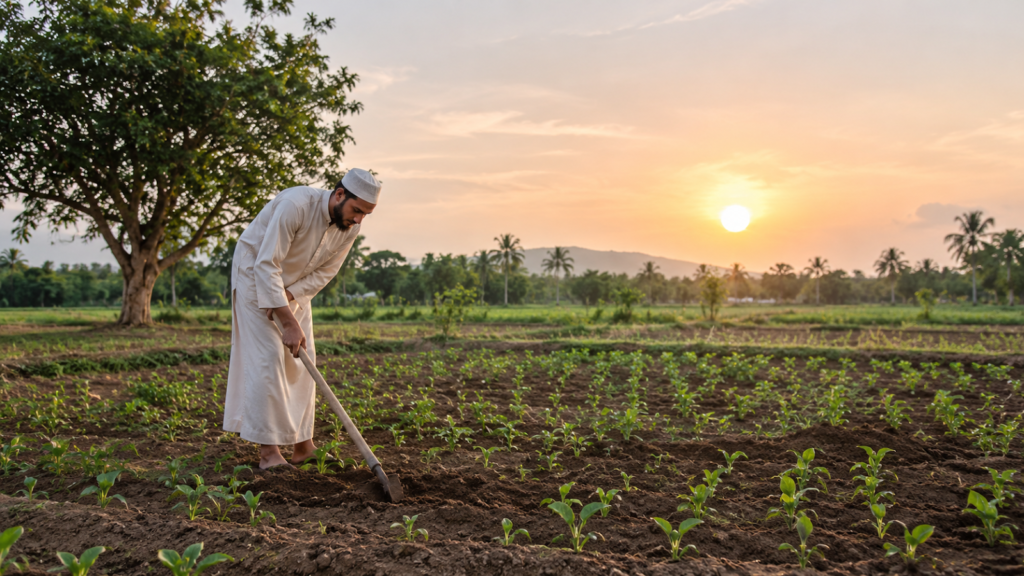
Ihya’ al-Mawat: The Law of Reviving Dead Land in Imam al-Nawawi’s Minhaj al-Talibin
Part 2: Transactions (Mu’amalat) – Reclaiming dead land (Ihya’ al-Mawat)
Part of a series on the structure of Minhaj al-Talibin, the classical Shafi’i legal manual. Section 16 of Part 2 (Transactions).
Introduction
After the Book of Lease and Hire, Imam al-Nawawi (631–676 AH / 1233–1277 CE) presents the Book of Reviving Dead Land (Kitab Ihya’ al-Mawat). The title refers to land that has no owner and is not in use, and the process by which a person can acquire it by bringing it to life through cultivation or construction. The book addresses a basic question of property law: how can a person come to own something that no one has owned before?
The answer in Islamic law is that effort makes the difference. The Prophet is reported to have said that whoever brings dead land to life, it belongs to him, and that a wrongdoer’s root, meaning someone who plants on another’s land, has no right. These statements form the basis of the book. This article follows its main themes in the general order of the Minhaj.
1. What is dead land
The term mawat refers to land that is not owned by anyone and is not currently used. It is typically unoccupied, uncultivated, and not claimed. The school distinguishes it from several other kinds of land:
- Land that is already owned, whether by private persons or by the state, even if it has been abandoned or is not now in use.
- Land that serves a public benefit, such as roads, markets, and areas that the community uses for grazing or gathering firewood.
- Land that is adjacent to a settlement and needed by its residents, which is treated as an extension of the settlement, so that a person cannot claim it through revival.
The book explains that the question is one of fact, and that the status of a particular area depends on its condition and the use made of it by the community.
2. Who may revive land, and the role of the ruler
In the Shafi’i school, a Muslim may acquire dead land in Muslim territory by reviving it, and does not need the ruler’s permission. This is another point on which the school differs from other schools, some of which require that permission be obtained. The school relies on the plain wording of the report. The book also gives rules about non-Muslims and about lands that were taken in conquest, and the status of land in different situations is explained according to the school’s categories.
The ruler retains the power to grant land (iqta’) to individuals for development, which gives them priority over it, while leaving the question of ownership to the same principles.
3. What counts as reviving
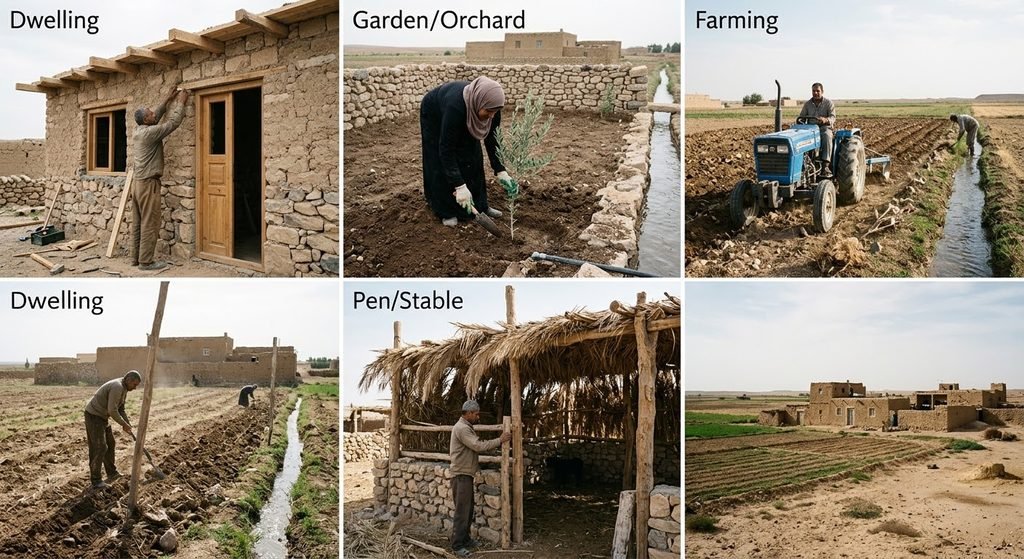
Ownership is acquired through revival, and revival is determined by custom, according to the purpose for which the land is being used. The book gives several examples:
- For a dwelling: building walls and a roof, so that the structure is habitable. The school requires that the structure be completed in a way that custom regards as a dwelling, and not merely a marking of boundaries.
- For a garden or orchard: enclosing the land, preparing it, providing water, and planting trees.
- For farming: leveling the ground, plowing or clearing it, and arranging water, whether by channeling or by ensuring rainfall can reach it.
- For a pen or stable: building walls and roof, to the extent that custom requires.
The principle is that the person must do the kind of work that, in the community’s judgment, brings the land into use for the purpose he intended. If the land is later abandoned, the school discusses whether ownership continues, and holds that it does, since ownership obtained by revival is not lost by neglect.
4. Marking and priority
A person who begins to work on land, for example by marking its boundaries or clearing part of it, but does not complete the revival, acquires a right of priority (tahjir) and not ownership. The school explains that this right prevents others from taking the land, so long as he continues his work within a reasonable period. If he delays without excuse, the ruler may set a time limit, after which another person who revives the land may take it. This rule balances the interest of the first worker with the need to prevent land from being held idle.
5. The surrounding area (harim)
A person who revives land may also acquire a surrounding space that is necessary for its use. The book describes this area for different structures. A house has a space for its courtyard, waste, and entrances. A well has an area where people can draw water and place their animals. A canal has a strip beside it for maintenance. The size of this space depends on need and custom, and the rule is that others may not reduce it by digging or building in a way that harms the existing user. Al-Nawawi shows that the right to revive land does not allow a person to harm the property that has already been brought to life.
6. Public rights: roads, markets, and mosques
The book then addresses rights over public places. A person may sit or set up a stall in a public road or market, provided he does not block passage or cause harm, and the school gives him a right of priority for the day as long as he remains. Similarly, a person who takes a place in a mosque, school, or hostel for a lawful purpose has priority for the time that he is there, and must give it up when he leaves. The ruler may allow such use or restrict it according to the public interest, and the school considers who is entitled to take precedence in cases of dispute.
7. Reserved land (hima)
The book mentions the practice in which the ruler reserves certain land for the public benefit, such as pasture for the animals used in the defense of the community or given in charity. This is permitted when it serves the public interest and does not unduly harm those who depend on the land. A private person has no right to reserve land for himself.
8. Minerals and water
The school treats exposed minerals, such as salt on the surface or water that flows naturally, as common resources that no one may monopolize. Concealed minerals, which require work to extract, raise further questions, and the book states the school’s conclusions about whether a person who digs them out acquires ownership or only a right to what he removes. As for flowing water, such as a stream or a river that serves many people, the book explains that the person who is upstream has the first right to irrigate, but must release the water to those below once his needs are met. The report in which the Prophet decided a dispute over irrigation is the model for this approach.
Why the order matters
The book proceeds from the definition of dead land to the right to revive it, then to what revival means, then to the rights of the one who has begun the work. It then turns to the surrounding space, public places, and shared resources. This order moves from private acquisition to the public sphere, and from the individual to the community. It helps the student understand that property rights arise from labor but are limited by the rights of others.
Closing reflection
For al-Nawawi, this book expresses a principle that runs through the whole law of transactions: that effort creates a right, and that the right is bounded by the needs of the community. The person who turns a barren place into a home or a field has earned it, but the roads, the water, and the pasture remain for all. The law of reviving land thus encourages productive use of the earth while protecting the commons from private capture.
Note: This article summarizes the general Shafi’i position as presented in Minhaj al-Talibin. Details, including the role of the ruler’s permission and the status of different kinds of land, differ among the schools and can vary between editions and commentaries. Modern land law involves additional legal frameworks, so readers who need a precise ruling should consult a qualified teacher or scholar.