
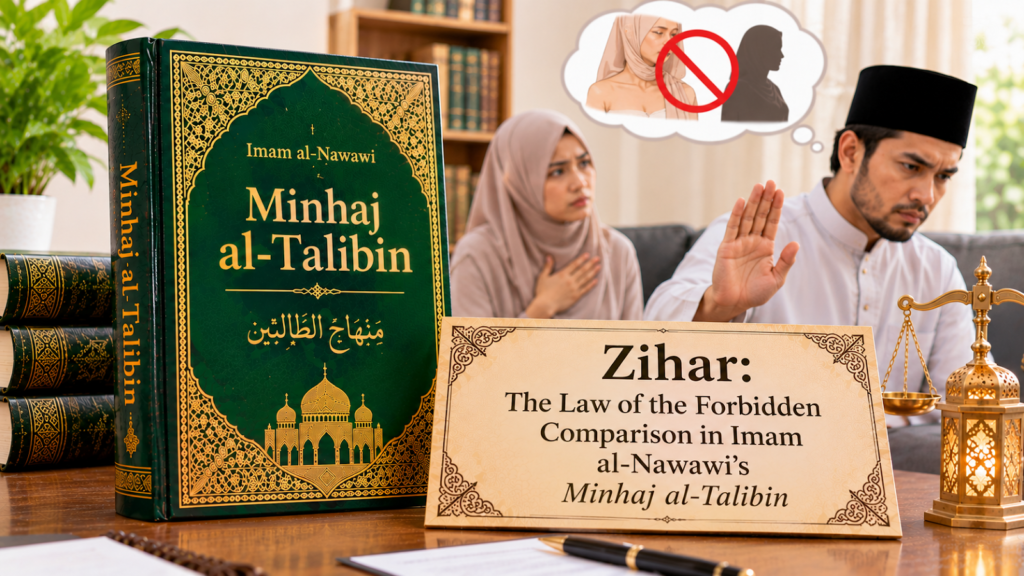
Zihar: The Law of the Forbidden Comparison in Imam al-Nawawi’s Minhaj al-Talibin
Part 3: Family Law (Munakahat) – Injurious comparison (Zihar)
Part of a series on the structure of Minhaj al-Talibin, the classical Shafi’i legal manual. Section 5 of Part 3 (Family Law).
Introduction
After the Book of the Oath of Abstention, Imam al-Nawawi (631–676 AH / 1233–1277 CE) presents the Book of the Forbidden Comparison (Kitab al-Zihar). The word comes from zahr, meaning back, and refers to a statement in which a husband says to his wife, “You are to me like my mother’s back.” In pre-Islamic Arabia, this phrase was used as a form of divorce, and it was a harsh one, because it left the wife in a state of suspension. She was no longer treated as a wife, yet she was not free to marry anyone else.
Islam addressed this practice directly. The Qur’an opens the chapter of the Disputant (al-Mujadilah) with the story of Khawlah bint Tha’labah, whose husband, Aws ibn al-Samit, had made this statement to her. She came to the Prophet to complain, and God revealed verses that condemned the statement as an evil word and a falsehood and that removed its pre-Islamic effect, replacing it with a set of rules and an expiation. This article follows the main themes of the book in the general order of the Minhaj.
1. The nature of zihar
In the legal sense, zihar is a husband’s comparison of his wife, or of a part of her body, to a woman who is permanently forbidden to him by relationship, such as his mother, in a manner that expresses prohibition. The school holds that it is a forbidden act, since the Qur’an calls it a wrongful statement, but that it does not end the marriage. The husband remains married, but he may not have marital relations with his wife until he has performed the expiation that the law prescribes. This is the central point of the book: the statement creates a temporary prohibition, which the husband must remove.
2. The pillars
The book lists the elements as the husband, the wife, the wording, and the woman to whom she is compared.
- The husband: he must be mature, sane, and acting by his own choice. A statement by a child, an insane person, or a person who is forced has no effect. The school applies the rules to any husband whose divorce would be valid.
- The wife: she must be in a valid marriage with the speaker. The school holds that a statement made to a woman who is not yet his wife, or in conditions where there is no marriage, has no effect. A wife in a revocable divorce, still within her waiting period, may be subject to the rule, since the marriage is still partly in force.
- The wording: the statement must express the comparison and the prohibition.
- The woman to whom she is compared: the school requires that she be someone who is permanently forbidden to him, such as his mother, grandmother, sister, daughter, or aunt, or a woman forbidden to him through nursing or marriage.
A statement made by a wife to her husband, comparing him to a forbidden male relative, does not have the effect of zihar, according to the school, since the power to end or suspend a marriage is not hers. The book treats it as a wrongful statement without the legal effects that attach to the husband’s words.
3. The wording
The school distinguishes clear and unclear wording:
- Clear wording: the statement that uses the word “back” or an equivalent for the mother or another forbidden relative, such as “You are to me like my mother’s back.” It takes effect without any need for an intention. The school applies the same to a comparison with another relative, and to a comparison with a part of the wife’s body.
- Wording that is open to interpretation: such as “You are like my mother” or “You are forbidden to me like my mother.” Here the husband’s intention is decisive. If he meant to express prohibition, it is zihar. If he meant to express respect, as in “you are like my mother in honor,” it has no legal effect. If he meant divorce, it is treated as an implicit statement of divorce, according to the rules of divorce.
The statement may be unconditional, or conditional, or limited in time, such as “You are to me like my mother’s back for a month.” The school holds that a temporary zihar is valid, and that the prohibition lasts until the end of the period, unless the husband has already expiated.
4. The effect and the return
Once the statement is made, the husband may not have marital relations with his wife until he performs the expiation. The Qur’an says that those who make this statement and then go back on what they said must free a slave before they touch one another. The school gives a particular interpretation to the phrase “going back.” In the Shafi’i view, it means that the husband keeps his wife in the marriage after the statement for a period long enough that he could have divorced her but did not. If he divorces her immediately, he has not gone back, and no expiation is required. If he keeps her, the expiation becomes due.
This understanding follows from the logic that the statement was intended to cast off the wife. Retaining her contradicts the statement, and the expiation is the price of that contradiction.
5. The expiation
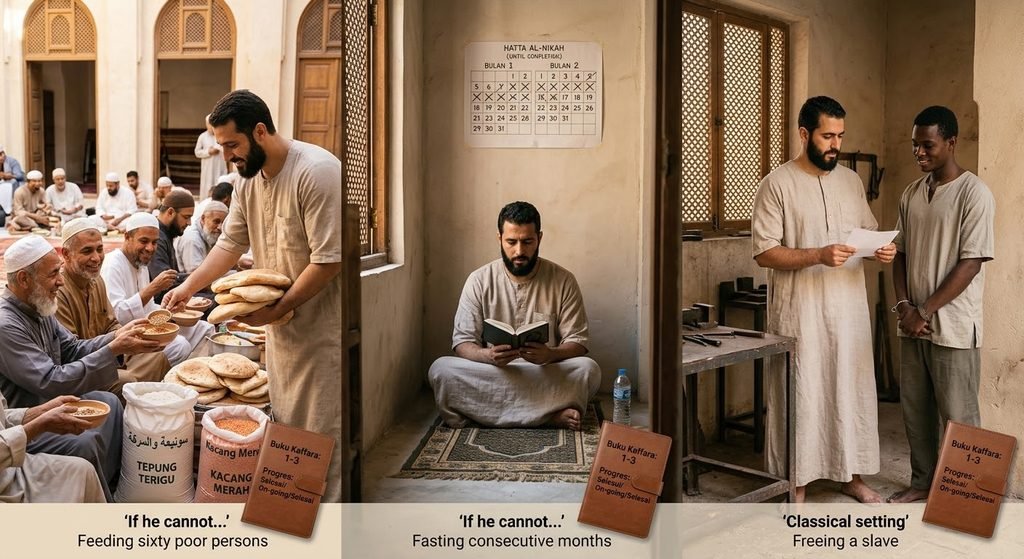
The expiation is a series of three steps, in order, each available only if the previous one is not possible:
- Freeing a believing slave. In the classical setting, this was the first and preferred step.
- Fasting two consecutive months, if the husband cannot free a slave. The school requires that the fast be continuous. If he breaks it without a valid reason, he must start again. He must also complete the fast before having relations with his wife.
- Feeding sixty poor persons, if he cannot fast, in which each person is given a measure of the staple food of the land. The school sets out the conditions regarding the amount and recipients.
The husband must complete the expiation before resuming marital relations. If he has relations before finishing, he commits a sin, but he owes only one expiation, according to the school’s relied-upon position. The Prophet’s instruction to a man who had done so, according to a report, was to refrain from approaching her again until he completed the expiation.
6. The wife’s rights
The wife is not obliged to wait indefinitely. The school holds that she may ask her husband to perform the expiation, or to divorce her, and she may bring the matter to the judge if he refuses. The judge may compel the husband to act and may use the means that the school describes. During the period, the husband must continue to provide maintenance, since the marriage remains. The wife may also refuse him relations until he has expiated, which the school treats as her right.
7. Relation to other topics
The book clarifies how zihar differs from similar acts. It differs from divorce, since it does not end the marriage. It differs from the oath of abstention, since there is no fixed period and the husband is not given a delay of four months, but must act as soon as the wife asks. It also differs from an ordinary oath, in that its penalty is fixed in the Qur’an. These distinctions help the student to identify which rules apply to a given case.
Why the order matters
The book begins with the nature of the act and its background, then sets out the pillars and the wording. It then explains the effect, the meaning of going back, and the three steps of expiation, and ends with the wife’s rights. This order follows the logic of the Qur’anic passage, which first condemns the statement, then removes its effect, then provides a remedy. It also shows the law’s primary concern: to protect a wife from being left in limbo by a statement that has no basis in the faith.
Closing reflection
For al-Nawawi, the rules of zihar illustrate how revelation reformed an unjust custom. It did not leave the statement as a means of casting off a wife, and it did not treat it as a trivial matter either. It placed a clear and costly expiation on the one who spoke it, and it protected the wife by making it possible for her to demand that the situation be resolved. The language of the Qur’an, which calls the statement an evil word, remains the moral center of the book.
Note: This article summarizes the general Shafi’i position as presented in Minhaj al-Talibin. Details, including the meaning of going back and the conditions of the expiation, differ among the schools and can vary between editions and commentaries. Family matters are also regulated by national laws, so readers who need a precise ruling should consult a qualified teacher or scholar.