Waqf: The Law of Endowment in Imam al-Nawawi’s Minhaj al-Talibin
Part 2: Transactions (Mu’amalat) – Endowment (Waqf)
Part of a series on the structure of Minhaj al-Talibin, the classical Shafi’i legal manual. Section 17 of Part 2 (Transactions).
Introduction
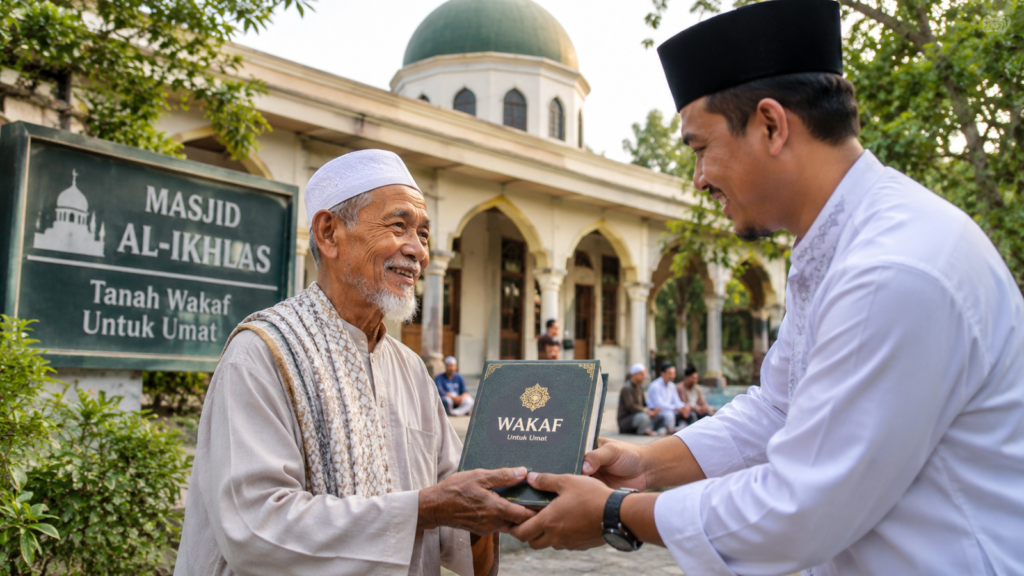
After the Book of Reviving Dead Land, Imam al-Nawawi (631–676 AH / 1233–1277 CE) presents the Book of Endowment (Kitab al-Waqf). A waqf, also called habs, is the dedication of a property so that its benefit is directed to a charitable purpose, while the property itself is held back from sale, gift, and inheritance. The word literally means to stop or to hold, and the principle is expressed in a well-known report about the Companion ‘Umar, who obtained a plot of land at Khaybar and asked the Prophet how best to use it. He was advised to hold the principal and to give its produce in charity, which he did, on the condition that it would not be sold, given away, or inherited.
The waqf is among the most enduring institutions of Islamic civilization. Mosques, schools, hospitals, water sources, and libraries were sustained for centuries by endowments. The tradition regards it as a form of ongoing charity (sadaqah jariyah), whose reward continues as long as the benefit continues. This article follows the main themes of the book in the general order of the Minhaj.
1. The pillars of waqf
The book identifies four essential elements:
- The wording (sighah): the statement that creates the waqf.
- The endower (waqif): the person who makes the dedication.
- The endowed property (mawquf).
- The beneficiary or purpose (mawquf ‘alayh).
Al-Nawawi gives conditions for each, which determine whether the endowment is valid.
2. The wording
The waqf is created by words that clearly express the intention, such as “I have endowed this land” or “I have made this property a waqf.” Some wording is regarded as explicit, and takes effect without an additional intention. Other wording, such as “I have given this in charity on the condition that it will not be sold,” is considered implicit and requires an intention to create a waqf. In the case of a mosque, the school discusses whether the construction of the building together with the permission for people to pray in it is sufficient, and holds that it may be, according to custom.
3. The endower
The endower must be competent to give property freely. This means that he must be mature, sane, acting by his own will, and not under legal restriction. A person who is under restriction because of poor financial judgment, or because of debts, cannot make a valid endowment, since it would harm those whose rights he must protect. A person in a fatal illness may endow only up to one third of his estate, in line with the rules on bequests.
4. The property
The property must be something that can be owned and sold, and whose benefit can be used while the thing itself remains. This includes land, buildings, animals, books, and tools. Items that are consumed in their use, such as food and fuel, cannot be endowed, since the principal would disappear. The property must also be specific and known, so that the endowment is not uncertain, and it must belong fully to the endower at the time. The school discusses whether a share of a larger property may be endowed, and holds that it may.
5. The beneficiary or purpose
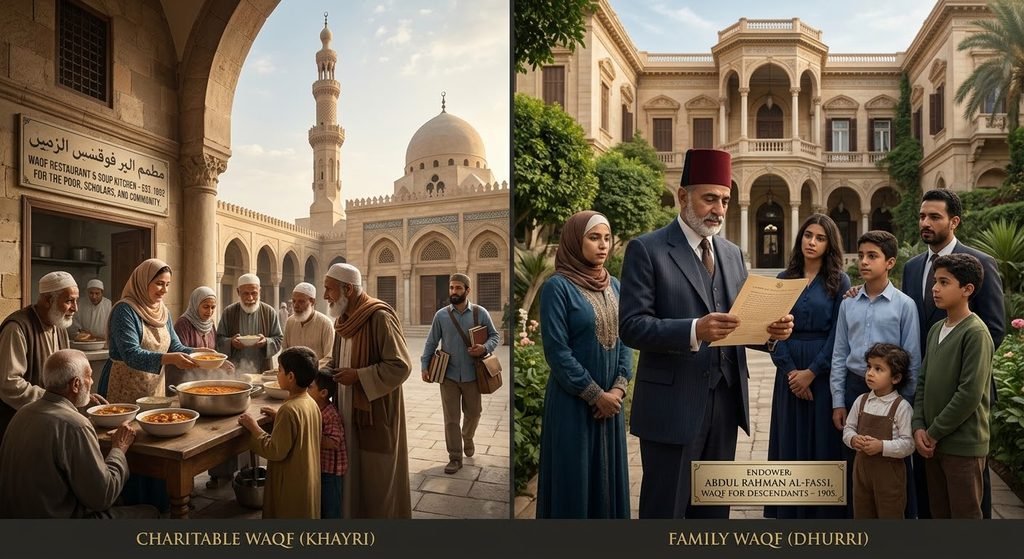
The waqf must be directed to a lawful and good purpose, or to a person or group who may legitimately benefit. The book distinguishes two kinds:
- Charitable waqf (khayri), for the poor, for scholars, for the maintenance of a mosque, and similar causes.
- Family waqf (dhurri), for the endower’s descendants or relatives, which then passes to a charitable purpose when the line ends.
A waqf for an unlawful purpose is not valid. The school’s relied-upon position is that a person cannot endow property for himself, since an endowment requires giving up one’s own ownership. The book also discusses the case where the beneficiaries are not specified or may cease to exist, in which the benefit passes to the poor.
6. Conditions of the contract
Several general conditions apply to the contract itself:
- Permanence: the waqf must be perpetual. A temporary waqf is not valid in the school’s position, since the point is to dedicate the property for good.
- Immediate effect: the endowment must take effect at once. A waqf made conditional on a future event, or on the endower’s death, is treated as a bequest, subject to the rules on bequests.
- No right of revocation: a stipulation that the endower may cancel the waqf or sell the property undermines its nature and invalidates it.
7. The effect of the waqf
Once the waqf is valid, the property can no longer be sold, given away, or inherited. In the school’s relied-upon position, ownership of the property passes to God, and the benefit belongs to the beneficiaries. The endower no longer has the right to dispose of it. The book addresses exceptional cases, in which the property is damaged or ceases to be useful. For instance, if a tree dries up, or the mats of a mosque become worn out, they may be used in a way that preserves the value, and in some cases may be sold with the proceeds used to buy a replacement, according to the school’s rules.
8. Management of the waqf
The waqf is managed by an administrator (nazir). The endower may appoint one in the document, and the school holds that his conditions are to be followed, as long as they are lawful. The administrator’s duties include maintaining and repairing the property, collecting its income, and distributing it to the beneficiaries according to the terms. The cost of maintenance is paid from the income first, since the continuation of the waqf depends on it. If the endower did not appoint an administrator, the school explains who holds this role, and the judge supervises in case of dispute or misconduct.
The principle that the endower’s wording is to be followed, as long as it does not contradict the law, is a central rule of this subject. Where the wording is unclear, the school looks to custom and the endower’s evident intention.
9. Disputes and special cases
The book ends with disputes and particular situations. These include conflicts among beneficiaries over their shares, and claims that a certain property is or is not a waqf. It also covers the waqf of a mosque and its special rules, in which the building cannot be sold or used for another purpose, and the rule that the endower may not take back his endowment even if his circumstances change.
Why the order matters
The book proceeds from the elements to the specific conditions of each, then to the effects of the contract and the way it is managed. This order follows the life of an endowment, from its creation to its administration over time. It also shows what distinguishes this contract from others in the book. In a sale, ownership moves from one person to another, and in a gift, a benefit is transferred, but in a waqf, the property is removed from the market altogether and dedicated to a purpose that outlasts its maker.
Closing reflection
For al-Nawawi, the waqf is one of the highest forms of generosity, since it joins a gift with a promise that the gift will endure. The strict conditions on permanence, immediacy, and lawful purpose protect the endowment from being undone, and they ensure that the endower’s act has a lasting effect. The report about ‘Umar’s land gives the institution its spirit: hold the principal, and let its fruit serve others.
Note: This article summarizes the general Shafi’i position as presented in Minhaj al-Talibin. Details, including the status of waqf for oneself, the question of temporary waqf, and the location of ownership, differ among the schools and can vary between editions and commentaries. Modern endowment structures involve additional legal considerations, so readers who need a precise ruling should consult a qualified teacher or scholar.