
Zakah: Obligatory Almsgiving in Imam al-Nawawi’s Minhaj al-Talibin
Part 1: Acts of Worship (Ibadat) – Almsgiving (Zakah)
Part of a series on the structure of Minhaj al-Talibin, the classical Shafi’i legal manual. Section 4 of Part 1 (Acts of Worship).
Introduction
After the books of purification, prayer, and funerals, Imam al-Nawawi (631–676 AH / 1233–1277 CE) presents the Book of Zakah (Kitab al-Zakah). Zakah is the third pillar of Islam in the usual enumeration and is paired with prayer in many verses of the Qur’an. Linguistically the word carries the sense of growth and purification, and the jurists explain that giving a fixed portion of one’s wealth purifies both the wealth and the giver.
Unlike the previous books, this one is largely a book of numbers: thresholds, rates, and categories of property. This article follows its main themes in the general order of the book.
1. Who must pay, and the basic conditions
Zakah is obligatory on a free Muslim who owns wealth of a zakatable type at or above the minimum threshold (nisab), with full and secure ownership. For most types of wealth, the property must also have been held for a full lunar year (hawl). Crops and fruits are the main exception, since their zakah is due at harvest.
Al-Nawawi also addresses the obligation on the property of minors and those lacking mental capacity, which is due from their wealth and paid by their guardian, as well as the position of someone who denies the obligation, which is a serious matter in the school.
2. Livestock
The book begins with grazing livestock (an’am), as is common in classical manuals: camels, cattle, and sheep or goats. Zakah is due on animals that graze freely for most of the year, with their own thresholds and prescribed amounts:
- Camels: the first obligation begins at five camels, for which one sheep is due, with a graduated scale beyond that.
- Cattle: the first obligation begins at thirty, for which a calf in its second year is due, with a graduated scale beyond that.
- Sheep and goats: the first obligation begins at forty, for which one sheep is due, increasing at higher counts.
The book describes the age and quality of the animals that may be taken, and the rule that the collector takes a medium animal, neither the best nor the worst. It also explains the concept of khultah, the mixing of the flocks of different owners, which the school treats in a specific way when the conditions of mixing are met.
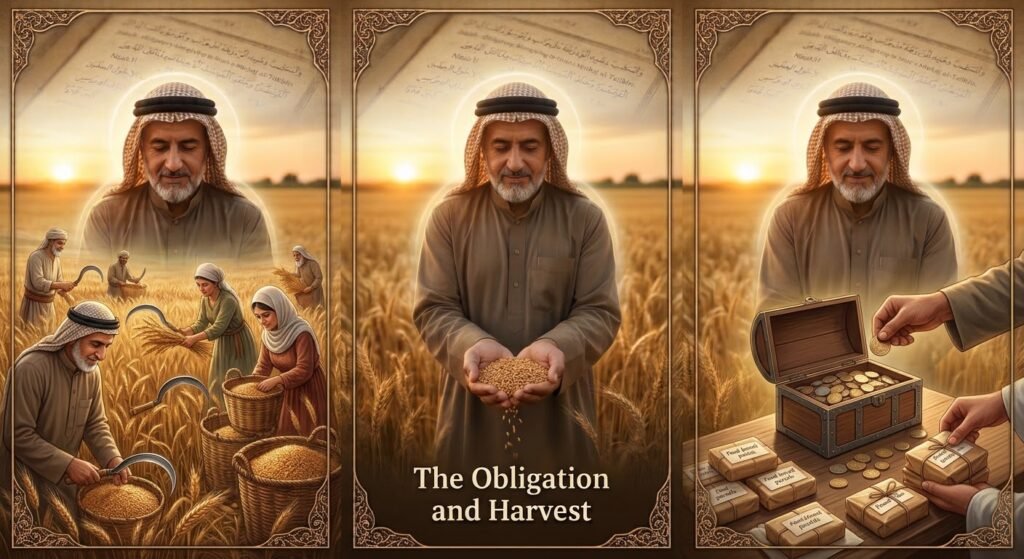
3. Crops and fruits
Zakah is due on staple crops that can be stored and are cultivated by people, and on dates and grapes. The threshold is five awsuq, which many contemporary scholars estimate at roughly 650 kilograms of the relevant grain, although estimates vary. The rate depends on how the land is watered:
- One tenth, if watered by rain or natural sources without effort.
- One twentieth, if irrigated with labor or cost.
The obligation applies at the time the grain hardens and the fruit ripens, and the book discusses estimation of the crop (khars) and the payment at harvest.
4. Gold and silver
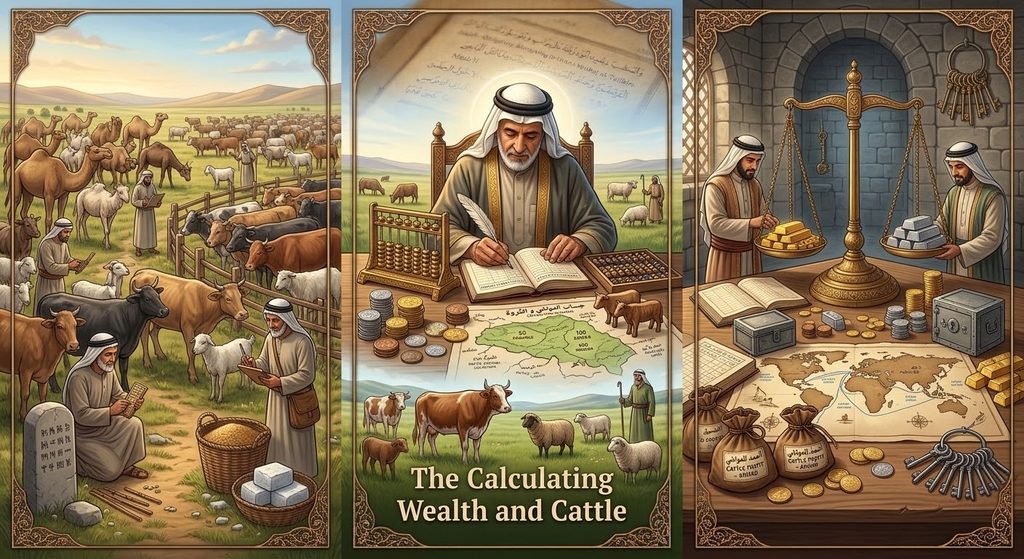
Zakah is due on gold and silver at a rate of one fortieth (2.5 percent). The threshold for gold is twenty mithqal, and for silver two hundred dirham, both of which are commonly converted into modern weights, though the figures given by scholars differ slightly. The book explains that the value of items made of these metals, such as coins and bullion, is included.
A well-known discussion concerns jewelry. In the Shafi’i position, jewelry that is permissible and intended for lawful adornment is not subject to zakah, while jewelry that is prohibited, or that is kept as a hoard, is. This point differs from other schools, and the book handles it carefully.
5. Trade goods
Goods held for commerce are treated by the school like money. At the end of the year, the owner evaluates the goods at their market value, and if the total reaches the threshold of gold or silver, zakah of 2.5 percent is due on the value. Al-Nawawi gives rules for how the year is counted, how profit relates to capital, and the effect of sales and purchases during the year.
6. Buried treasure and minerals
Two categories are treated separately. Rikaz refers to treasure buried in the pre-Islamic period and found by someone, on which one fifth is due immediately, without the need for a year to pass. Minerals extracted from the earth, specifically gold and silver, are subject to a rate and conditions that the book describes in the Shafi’i position.
7. Zakat al-Fitr
At the end of Ramadan, every Muslim who has food in excess of their needs and the needs of their dependents on the day and night of the festival must give zakat al-fitr. The amount is one sa’ of the staple food of the land per person, which is commonly estimated at around 2.5 to 3 kilograms depending on the grain. The head of the household pays for dependents. The book also discusses the proper timing, which extends from the beginning of Ramadan through to the festival prayer, with the recommendation not to delay it past the prayer.
8. Conditions of payment
Zakah is an act of worship, so it requires intention (niyyah) at the time of payment or when setting aside the amount. The owner may pay it directly or through an authorized agent, and al-Nawawi discusses the rulings on advance payment, delay, and the liability of someone who negligently delays it until after the property is lost.
9. The recipients
The recipients are the eight categories named in the Qur’an (al-Tawbah 9:60): the poor, the needy, those employed to collect zakah, those whose hearts are to be reconciled, those in bondage, those in debt, those in the cause of God, and the wayfarer. In the structure of Minhaj al-Talibin, the detailed rules on the distribution of zakah and the qualifications of each category appear later in the book, in the chapter on the distribution of charity, which is why a student following the book in order encounters the obligation first and the recipients afterward.
Why the order matters
The book moves from the property that was most central in the economy of the early community, livestock and agriculture, to money and trade, and then to the special cases of treasure and the festival charity. Each section answers the same questions in the same order: who is liable, what is the threshold, what is the rate, and when is it due. Recognizing that pattern makes a long and technical book much easier to remember.
Closing reflection
For al-Nawawi, zakah is a legal duty with precise boundaries, and it is also an expression of the principle that wealth is a trust. The thresholds protect the person of modest means, while the rates and categories make sure that a defined portion reaches those in need. The numbers serve a moral aim: the circulation of wealth within the community and the purification of the heart from greed.
Note: This article summarizes the general Shafi’i position as presented in Minhaj al-Talibin. Modern equivalents for classical units such as the nisab, the sa’, and the mithqal are estimates and vary between scholars and institutions. Readers who need to calculate their own zakah should consult a qualified teacher or a reliable zakah authority.