
Janazah: Funeral Rites in Imam al-Nawawi’s Minhaj al-Talibin
Part 1: Acts of Worship (Ibadat) – Funerals (Janazah)
Part of a series on the structure of Minhaj al-Talibin, the classical Shafi’i legal manual. Section 3 of Part 1 (Acts of Worship).
Introduction
After purification and prayer, Imam al-Nawawi (631–676 AH / 1233–1277 CE) turns to the Book of Funerals (Kitab al-Janaiz). At first glance this may seem to sit oddly among acts of worship, but the jurists placed it here for good reason. Caring for the dead is itself an act of devotion, and it draws on the two subjects just covered: the body is purified, and a prayer is performed over it.
A defining feature of this book is that its core duties are fard kifayah, communal obligations. If enough members of the community carry them out, the obligation is lifted from the rest. If no one does, all are accountable. This article follows the main themes of the book in their general order.
1. Remembering death and caring for the sick
The book begins gently, with the recommendation to remember death often and to prepare for it through repentance, the return of rights owed to others, and written or spoken instructions. Visiting the sick is encouraged, as is supplicating for them and encouraging them to think well of God.
2. The person at the point of death
Al-Nawawi then describes the etiquette of attending someone who is dying. The main recommendations are:
- Turning the person toward the qiblah, in the manner the school describes.
- Prompting them gently to say the declaration of faith (talqin), without pressing them, and without asking them to repeat it once they have said it, unless they speak of something else afterward.
- Reciting Qur’an near them, in particular Surat Yasin according to the school’s recommendation.
- Closing the eyes after death, with a supplication, and covering the body.
- Hastening to settle the person’s debts and to carry out their lawful bequests.
3. Washing the body (ghusl al-mayyit)
Washing a deceased Muslim is a communal obligation. The book explains who is preferred to perform it: for a man, men who are most closely related or otherwise qualified, and for a woman, women, with the spouses having a recognized role as well. The minimum required is that the water reaches the whole body, while the complete method involves removing impurities first, performing a wudu’ like that of prayer, and washing the body in a manner the book describes, with camphor added in the last rinse.
A person who washes the body should be trustworthy and should keep from others any defects they may see. The school also gives rulings for cases in which washing is not possible, such as when there is no water or when the body would be harmed, in which case tayammum is performed.
4. Shrouding (takfin)
Shrouding the body is also a communal obligation. The minimum is a single garment that covers the entire body. The recommended form, according to the school, is three wrappings for a man, while the book describes a fuller set for a woman. White cloth is preferred, and extravagance is discouraged. The cost of the shroud is taken from the deceased’s estate, before debts and bequests, and if the person has no estate it falls on those responsible for their maintenance.
5. The funeral prayer (salat al-janazah)
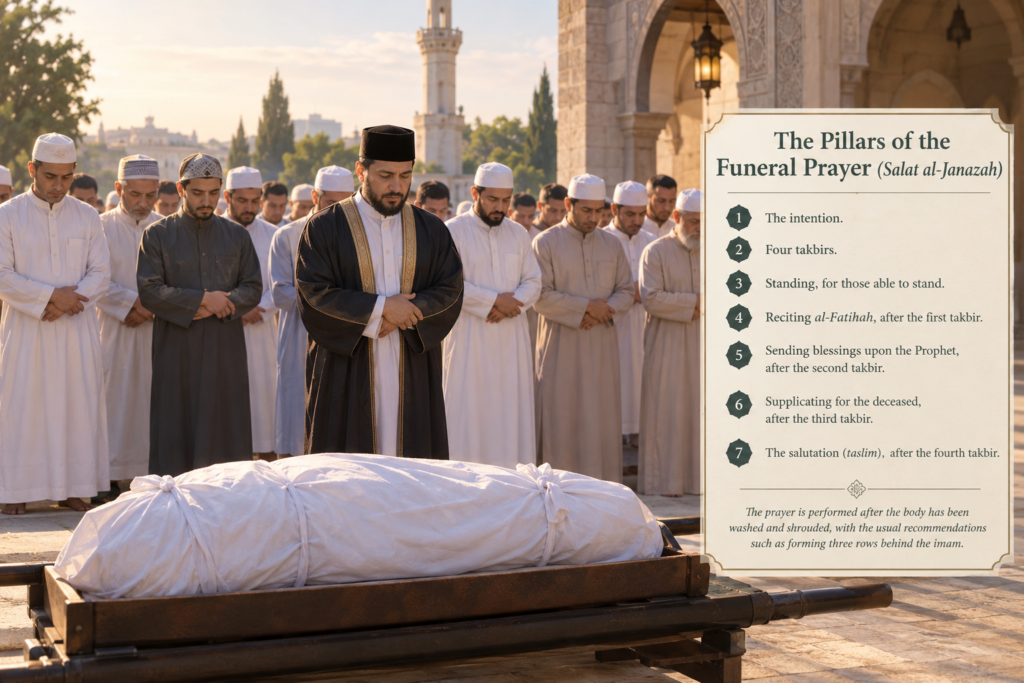
The funeral prayer is a communal obligation. It is unusual in that it has no bowing or prostration. According to the school, its pillars are:
- The intention.
- Four takbirs.
- Standing, for those able to stand.
- Reciting al-Fatihah, after the first takbir.
- Sending blessings upon the Prophet, after the second takbir.
- Supplicating for the deceased, after the third takbir.
- The salutation (taslim), after the fourth takbir.
The prayer is performed after the body has been washed and shrouded, and the book notes recommendations such as forming three rows behind the imam and where the imam stands in relation to the body of a man and of a woman. The supplication for the deceased is the heart of the prayer, and al-Nawawi mentions the well-known wording transmitted from the Prophet.
6. Who is prayed over
The book distinguishes among several categories:
- A deceased Muslim: washed, shrouded, and prayed over.
- The martyr who dies in battle with the unbelievers: in the Shafi’i position, not washed and not prayed over, but buried in his clothes.
- A child or stillborn infant: the rulings depend on whether signs of life appeared, or whether the child had reached a stage of development, which the book details.
- A non-Muslim: not prayed over, though burying and shrouding rulings are discussed.
- An absent deceased person: the school permits a prayer in absentia under certain conditions.
7. Carrying the body and burial
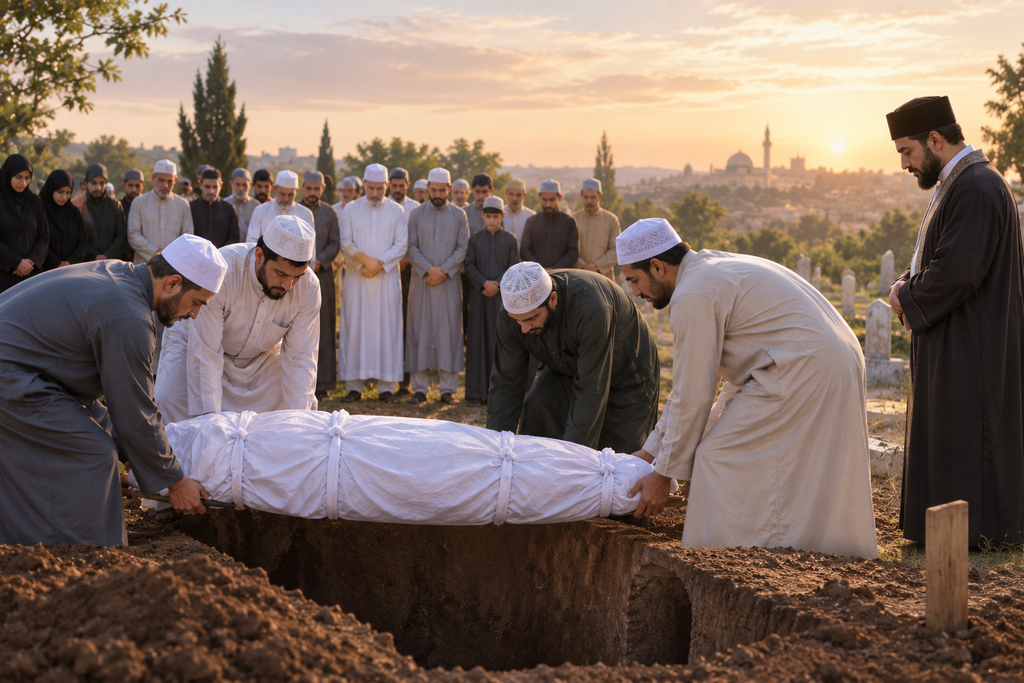
The book recommends hastening the funeral and walking in the procession. On burial, it describes the recommended form of the grave, either a lahd (a niche dug into the side of the grave) or a shaqq (a trench in the center), with the lahd being preferred where the soil allows. The body is placed on its right side facing the qiblah, the knots of the shroud are undone, and the grave is filled with earth. Al-Nawawi gives the recommended supplications at this point and the guidance to raise the grave slightly from the ground, without building over it or plastering it.
He also addresses special situations, such as burial at sea, burial of more than one person in a single grave when there is a need, and the exhumation of a body, which is generally prohibited except for a valid reason.
8. Condolences and mourning
Offering condolences (ta’ziyah) to the bereaved is recommended. The book explains the wording and the time, and the recommendation that neighbors and relatives prepare food for the family of the deceased. Quiet weeping is permitted, while wailing, tearing the clothes, and striking the face are prohibited. Al-Nawawi treats the topic with compassion, reflecting the dual purpose of the Islamic funeral: honoring the dead and consoling the living.
Why the order matters
The structure of the book follows the sequence of events in real life: illness, the moment of death, washing, shrouding, prayer, burial, and then the consolation of the bereaved. A student who learns the chapter in this order learns it as a practical guide as well as a body of rulings. It also shows how closely the funeral rites are tied to earlier books: purification comes before washing, and the prayer rules shape the janazah prayer.
Closing reflection
For al-Nawawi, the funeral rites express the dignity the tradition gives to every human being, even in death. They are also a reminder to the living. The book that comes between prayer and almsgiving quietly teaches the worshipper that every act of devotion is bound to an end, and that preparation for it is part of faith.
Note: This article summarizes the general Shafi’i position as presented in Minhaj al-Talibin. Details can vary between editions and commentaries, so readers who need a precise ruling should consult a qualified teacher or the standard commentaries.