

Wadi’ah: The Law of Deposits in Imam al-Nawawi’s Minhaj al-Talibin
Part 2: Transactions (Mu’amalat) – Deposits (Wadi’ah)
Part of a series on the structure of Minhaj al-Talibin, the classical Shafi’i legal manual. Section 23 of Part 2 (Transactions).
Introduction
After the Book of Bequests, Imam al-Nawawi (631–676 AH / 1233–1277 CE) presents the Book of Deposits (Kitab al-Wadi’ah). A wadi’ah is property that a person leaves with another for safekeeping, without payment and without transferring ownership. A traveler who leaves his belongings with a neighbor, a merchant who stores goods with a trusted friend, and a person who leaves valuables with a reliable acquaintance before a journey are all examples. The person who gives the property is the depositor (muwdi’), and the person who keeps it is the custodian (mustawda’).
The law of deposits rests on one of the great moral principles of the revelation: the duty to keep trust. The Qur’an commands believers to return trusts to their rightful owners, and the tradition records the saying of the Prophet to return the trust to the one who entrusted it, and not to betray even one who has betrayed you. This article follows the main themes of the book in the general order of the Minhaj.
1. The nature and the ruling
The deposit is a contract of trust. The custodian takes responsibility for the safety of the property, but does not own it and may not use it. The school holds that accepting a deposit is recommended for a person who is trustworthy and capable of protecting it, since it is a form of helping another. It becomes obligatory if there is no one else who can serve, and the owner would otherwise suffer loss. It is disliked for a person who is not sure he can protect the property or who does not trust himself, as he may expose it to loss.
2. The pillars of the contract
The book lists the elements as the wording, the depositor, the custodian, and the item deposited. The wording is an offer by the depositor, such as “I entrust this to you,” and acceptance by the custodian. The school does not require a formal statement of acceptance. It is enough that the custodian takes the item with the intention of keeping it, or says something that indicates he agrees.
Both parties must be competent to contract. The depositor must be mature, sane, and have the right to dispose of the property, and the custodian must be competent to hold a trust. A deposit made by a child or an incompetent person is not a valid deposit, and a custodian who takes it without the guardian’s permission may be liable for its loss, since he took it from a person who had no right to hand it over. He is released from liability by returning it to the guardian.
The item may be any property that can be kept, including things that are impure but have a lawful use, according to the school.
3. A permitted, non-binding contract
The deposit is a permitted contract, not a binding one. Either party may end it at any time. The depositor may ask for his property back whenever he wishes, and the custodian may return it whenever he wishes, though he should give the depositor a reasonable opportunity to make other arrangements. The contract also ends if either party dies or loses his reason, in which case the property is returned to the depositor or his heirs.
4. The custodian as a trustee
The central principle of the book is that the custodian is a trustee (amin). He is not liable if the property is lost or damaged without negligence or misuse on his part. A report states that a trustee is not liable, and the school applies the rule to deposits. This is a significant contrast with the loan for use, in which the borrower is liable for the item even if he was not at fault, since the loan is for his benefit, while the deposit is for the benefit of the depositor.
5. The custodian’s duties
The custodian must keep the property in a secure place, as custom requires for items of that kind. The book describes what counts as a suitable place, such as a locked room or a safe for valuables and a stable for an animal. If the depositor specifies a place and the custodian puts it in a less secure one, he is liable. If he puts it in a more secure one, he is not. The custodian must also take reasonable steps to protect it from danger, such as fire, flood, or theft, if he can do so.
The custodian may not use the item without permission. If he does, the contract is violated and he becomes liable. He may not mix it with his own property in a way that makes them indistinguishable, and he may not carry it on a journey or give it to another person to keep, unless there is a good reason, such as an emergency, or the depositor allows it. If the custodian is about to travel, he must return the property to the depositor or his agent, or, if neither is available, to the judge or a trustworthy person.
6. Causes of liability
The school distinguishes two causes by which a custodian becomes liable. The first is negligence (taqsir), such as leaving the property in an unprotected place. The second is transgression (ta’addi), such as using it, mixing it, or denying that he holds it. If the custodian denies that he has the deposit, and it is later shown that he does, he is considered a transgressor, and he is liable for it from that time. In the school’s relied-upon position, once he is liable through transgression, he remains liable until he returns the property to the owner, even if he later puts it back in safekeeping, unless the owner renews his trust.
7. Returning the deposit
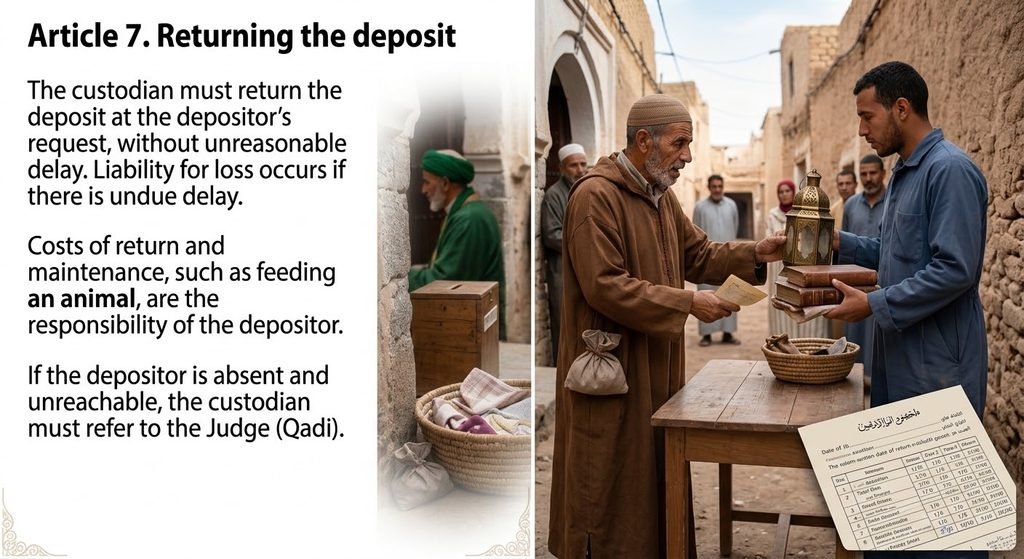
The custodian must return the deposit when the depositor requests it, at the first opportunity, and without unreasonable delay. If he delays after a demand, and the property is lost during the delay, he is liable. The cost of returning the item falls on the depositor, as does the cost of maintaining it, such as feeding an animal. If the custodian spends on it with the depositor’s permission, he may claim the amount. If the depositor is absent and the custodian cannot reach him, the school instructs the custodian to refer the matter to the judge.
8. Special situations
The book treats unusual cases, such as the case of a custodian who fears that a tyrant will seize the deposit, and the cases of danger from fire or of enemy attack. In such cases the custodian may take reasonable action, even if it involves moving the property, without becoming liable, as long as he acts in good faith. It also treats the death of the custodian. If it is known that the deposit is among his property, it is returned to the owner. If it cannot be found, and it was not properly recorded, it is treated as a debt owed from his estate.
9. Disputes
The final section of the book discusses disputes. If the custodian says that the property was lost, or that he returned it, his word under oath is generally accepted, since he is a trustee, unless there is evidence against him. If he claims that he returned it to someone other than the depositor, such as the depositor’s heir or agent, he needs proof. If the depositor claims that the custodian transgressed or was negligent, the depositor must prove it. These rules protect the custodian from unjust claims, and also help the owner to guard against dishonesty.
Why the order matters
The book begins with the nature of the deposit and its ruling, then states the pillars, then the principle of trusteeship, and then the duties and causes of liability. It ends with the return of the property and disputes. This order follows the sequence in which an actual deposit proceeds: the entrusting, the keeping, the possibility of loss or misuse, and the return. It also shows that the law’s concern is to protect both sides, the owner from betrayal and the custodian from unfair blame.
Closing reflection
For al-Nawawi, the law of deposits is the legal form of a moral virtue, trustworthiness. The custodian does a favor with no reward in this world, and the law repays him by not holding him liable for what he could not prevent. The owner, in turn, is protected from any misuse by clear rules on liability. The result is a contract that encourages people to help each other with their possessions, which is why the tradition treats the keeping of trusts as a mark of faith.
Note: This article summarizes the general Shafi’i position as presented in Minhaj al-Talibin. Details, including the effect of transgression on the custodian’s later liability, can vary between editions and commentaries and differ among the schools. Modern custody and storage arrangements involve additional legal considerations, so readers who need a precise ruling should consult a qualified teacher or scholar.