
Qasm al-Fay’ wa al-Ghanimah: Distribution of Fay’ and Spoils in Imam al-Nawawi’s Minhaj al-Talibin
Part 2: Transactions (Mu’amalat) – Distribution of war spoils (fay’ and ghanimah)
Part of a series on the structure of Minhaj al-Talibin, the classical Shafi’i legal manual. Section 24 of Part 2 (Transactions).
Introduction
After the Book of Deposits, Imam al-Nawawi (631–676 AH / 1233–1277 CE) presents the Book of the Distribution of Fay’ and Ghanimah (Kitab Qasm al-Fay’ wa al-Ghanimah). This is a book of classical public law. It deals with property that came into the hands of the Muslim community, under its ruler, as a result of conflict with an opposing party in the premodern world, and it sets out how such property is to be accounted for and distributed. It belongs among the books of transactions because its subject is the allocation of wealth, and because it concerns rights of ownership and entitlement that parallel those in the law of inheritance and charity.
The reader should keep in mind that this book describes the rules of the classical jurists in the context of the political and military institutions of their time. It is a work of historical legal doctrine, and modern states and international law operate within different frameworks. This article follows the main themes of the book in the general order of the Minhaj, as an account of what the school taught.
1. The two categories of property
The classical jurists distinguished two kinds of property that the community might acquire from opposing forces:
- Fay’: property taken from non-Muslims without fighting, for example property left behind when its owners withdrew in fear, tribute, and the poll tax paid by non-Muslim subjects under the community’s protection.
- Ghanimah: property taken by force in the course of fighting, including goods, weapons, animals, and captives.
The Qur’an addresses both. The chapter of the Gathering (al-Hashr) describes the fay’ and lists those who are entitled to it, while the chapter of the Spoils (al-Anfal) sets out the one-fifth share of the spoils for specific purposes.
2. The treatment of fay’
In the Shafi’i school, as presented in the Minhaj, the fay’ is divided into five parts. One fifth is set aside for five categories named in the Qur’an: the share assigned to God and His Messenger, which after the Prophet’s death goes to the public interests of the Muslims; the relatives of the Prophet, namely the families of Hashim and al-Muttalib; the orphans; the poor; and the wayfarers. The remaining four fifths are allocated to the public interest, in particular to the registered soldiers who make up the standing army, and the ruler manages it according to their needs and the needs of the community. The school explains that this reflects a distinction between fay’, which is a resource of the state, and spoils, which are the earnings of those who took part in the fight.
3. The treatment of ghanimah: the order of allocation
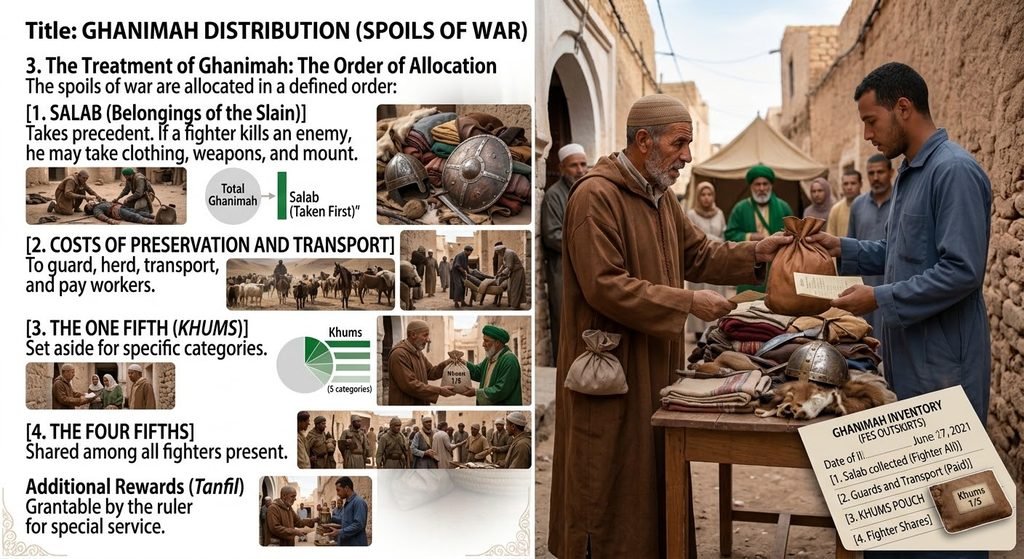
The spoils of war are allocated in a defined order, which the book sets out:
- The belongings of the slain (salab): if a fighter kills an enemy combatant in battle, in the manner the school describes, he may take the slain man’s clothing, weapons, and mount, as the Prophet is reported to have declared. This is taken before any distribution.
- The costs of preserving and transporting the spoils: such as guarding, herding, and transport, including the payment of those who performed the work.
- The one fifth (khums): set aside for the five categories mentioned above.
- The four fifths: distributed among the fighters who were present.
The school adds that the ruler may grant additional rewards (tanfil) from the remaining property to those who performed special service, such as scouting or undertaking a dangerous task, within the limits that the book describes.
4. The shares of the fighters
The four fifths are divided among those who took part in the fighting, or were present with the intention to fight. The Shafi’i school follows the practice reported from the time of the Prophet. A mounted fighter receives three shares, two for his horse and one for himself, and a foot soldier receives one. The school gives rules for the case of a fighter who joins after the battle has begun, or who is prevented from fighting, and for one who dies before the distribution. The book states that the share belongs to a person who was present and was capable of fighting.
Those who are not full participants, such as women, children, slaves, and non-Muslims who accompany the army, do not receive a full share, but the ruler may give them a smaller reward (radkh) according to their service. This rule recognizes their contribution without equating it with the shares of the fighters.
5. Captives and land
The book also deals with captives and with land that came under the community’s control. For captives taken in battle, the school holds that the ruler chooses the option that best serves the community’s interest from among several: releasing them with or without ransom, exchanging them for Muslim prisoners, or other options that the book enumerates. These are rules of the classical period and reflect the conditions of that time.
As for land, the school’s position is that it is treated as spoils and is divided among the fighters unless they voluntarily give up their right, which allows the ruler to keep it as a public endowment for the benefit of the community. The school cites the practice of the second caliph, who did not divide the conquered lands of Iraq and kept them as a resource for the generations that followed, after obtaining the consent of those entitled.
6. Honesty and accountability
The tradition places great weight on honesty in the handling of spoils. A Qur’anic verse and several reports warn against taking any part of the booty before it has been distributed, which is called ghulul, and describe it as a serious sin. The school explains that every item must be brought to the ruler’s attention, and the fighter who takes something in secret is liable, in addition to the moral guilt. The book also discusses small amounts of food and fodder that the fighters may use freely during the campaign, since they are necessary and not subject to distribution, and the rules for this.
7. The role of the ruler
The ruler is responsible for ensuring a just and orderly distribution. He must keep proper records, appoint trustworthy people to oversee the spoils, and follow the school’s rules in dividing them. The book also states that the ruler has discretion in the distribution of the public share, which he must exercise for the benefit of the community and without favoritism toward individuals.
Why the order matters
The book begins with the definitions, which allow the student to see the two types of property and their different rules. It then treats the fay’ and spoils in turn, with the order of the allocations, and ends with the special cases of captives and land and the duties of integrity. This order follows the path that the property itself would take, from its acquisition to its distribution, and it shows the school’s concern that every stage be accounted for.
Closing reflection
For al-Nawawi, this book is a part of the law of public wealth. The rules ensure that property obtained in conflict is not seized by individuals or concentrated in the hands of rulers, but is divided according to defined shares, with a portion reserved for the vulnerable and the public good. The strictness of the warning against hidden appropriation reflects the same concern for honest handling of common property that appears throughout the law of transactions.
Note: This article summarizes the classical Shafi’i position as presented in Minhaj al-Talibin and describes historical legal doctrine. Details, including the division of fay’ and the treatment of captives and land, differ among the schools and can vary between editions and commentaries. Contemporary questions about war, public finance, and the treatment of prisoners are governed by modern law and by scholarly discussion that takes account of present circumstances, so readers who need guidance should consult a qualified scholar.