
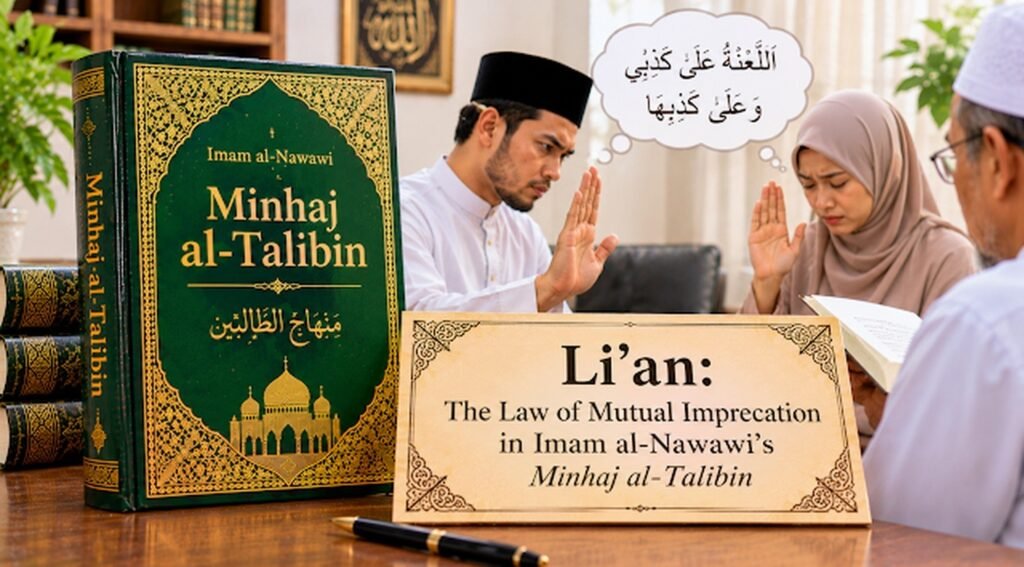
Li’an: The Law of Mutual Imprecation in Imam al-Nawawi’s Minhaj al-Talibin
Part 3: Family Law (Munakahat) – Mutual imprecation (Li’an)
Part of a series on the structure of Minhaj al-Talibin, the classical Shafi’i legal manual. Section 6 of Part 3 (Family Law).
Introduction
After the Book of the Forbidden Comparison, Imam al-Nawawi (631–676 AH / 1233–1277 CE) presents the Book of Mutual Imprecation (Kitab al-Li’an). The word li’an comes from the root meaning to curse, since the procedure involves each spouse calling down God’s curse or wrath upon themselves if they are lying. In the legal sense, it is a set of sworn statements by which a husband who accuses his wife of adultery, or denies the paternity of her child, and has no witnesses, can avoid the penalty for false accusation, and by which the wife can avoid the penalty that his accusation would otherwise bring upon her.
The subject is a grave one, and the tradition handles it with great care. The Qur’an sets out the procedure in the chapter of Light (al-Nur), in a passage that follows the rules on false accusation. In general, anyone who accuses another of adultery without producing four witnesses is subject to a penalty. The verses on li’an provide an exception for the husband, who may be the only witness to what happened in his own household. The tradition records the case of Hilal ibn Umayyah, who accused his wife, and the revelation that followed. This article follows the main themes of the book in the general order of the Minhaj, and it describes classical legal doctrine.
1. The background in the law of accusation
To understand li’an, one must see the rule it modifies. The law treats the accusation of adultery as a serious offense, because it damages a person’s reputation, and it requires strict proof. A person who makes the accusation without four eyewitnesses is subject to a fixed penalty for false accusation. A husband who sees or has certain knowledge of his wife’s infidelity is in a difficult position. He may have no witnesses, yet he would be punished if he speaks. The verses of li’an give him a way out: by taking the oaths described, he escapes the penalty and places the burden on the wife.
2. When it is permitted
The book states the circumstances in which a husband may carry out li’an. It is permitted for a husband who has seen his wife commit adultery, or who is otherwise certain, for example by knowing that a child cannot be his because of a long absence or other conclusive reason. It is also permitted, and in certain cases obligatory, to use it to deny a child who is not his, since otherwise the child would be wrongly attributed to him. The school stresses that a husband who has only a suspicion, or who relies on resemblance or rumor, is not allowed to take the oaths, and doing so would be a serious sin. The book notes that the Prophet advised concealment where possible, and that the husband should consider carefully before proceeding.
3. The conditions
The book lists the conditions for a valid li’an:
- A valid marriage between the two parties at the time of the accusation, even if the wife is in the waiting period after a revocable divorce.
- A competent husband, who is mature, sane, and acting by choice, and a wife who is competent in the same way.
- An accusation, made in a form that is an unambiguous charge of adultery or a denial of the child’s paternity.
- A judge, since the procedure takes place before a judge or his appointee, and not privately.
The school adds that a husband who wishes to deny a child must do so promptly, since delay without a valid excuse is taken as acceptance of the child’s lineage. The book explains what counts as an excuse and how long the delay may be.
4. The procedure
The procedure is formal and follows the Qur’anic wording. It is held in front of the judge, and the school recommends that it take place in the presence of a group of people, at an honored time and place, to emphasize its gravity.
- The husband goes first. He says four times, “I bear witness by God that I am truthful in what I have accused my wife of, regarding adultery,” and if he is denying a child, he adds that the child is not his. The fifth time he says, “May the curse of God be upon me if I am of the liars.” Before the fifth statement, the judge reminds him of the seriousness of the oath and tells him that the punishment of this world is lighter than that of the Hereafter, as the Prophet is reported to have done.
- The wife then responds. She says four times, “I bear witness by God that he is lying in what he has accused me of,” and the fifth time, “May the wrath of God be upon me if he is truthful.” The judge gives her the same reminder before the fifth statement.
The school requires that the exact words be used, and that the statements follow in order without interruption. The book discusses how the procedure is carried out when one party cannot speak, or does not know the language.
5. The effects
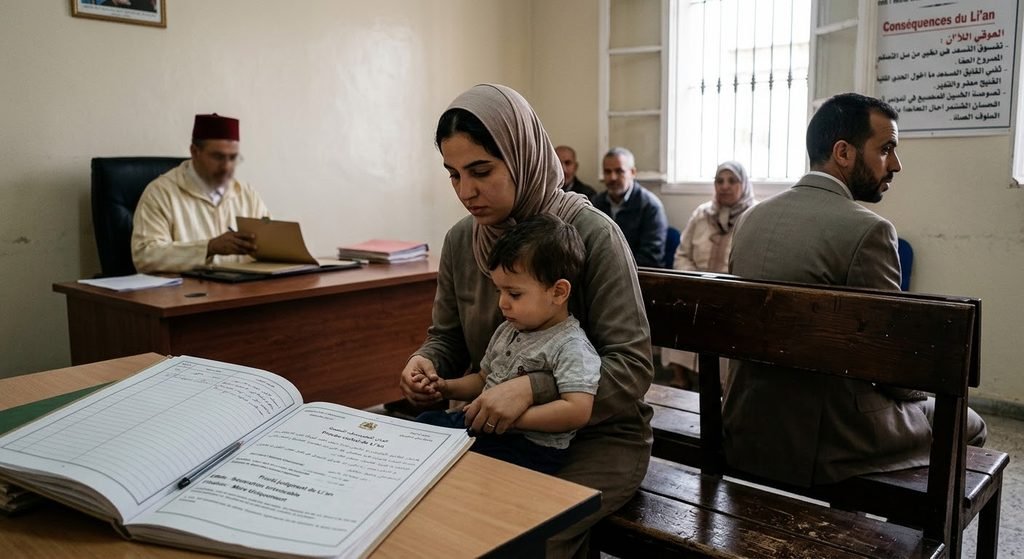
The consequences of li’an are significant, and the book sets them out carefully.
- If the husband completes his oaths, he avoids the penalty for false accusation, and the wife becomes liable to the penalty for adultery that his statements establish, unless she responds.
- If the wife completes her oaths, she avoids that penalty. The accusation is not proven, and neither party is punished.
- The marriage is ended by the husband’s oaths, according to the school, or by both parties’ oaths, with the separation being final. The school’s position is that the spouses are permanently forbidden to one another, and the wife is no longer lawful for him even if he later retracts or they both wish to reunite.
- The child’s lineage, if denied, is cut off from the husband and attached to the mother. The child inherits from the mother and her family, and not from the husband, and there are no maintenance obligations on the husband for the child.
If the husband refuses to take the oaths, he is subject to the penalty for false accusation, unless he withdraws the charge. If the wife refuses to respond to the oaths of the husband, the penalty for adultery applies to her, according to the school’s rules, and the book explains the conditions and cases. If a party retracts after the procedure and admits to falsehood, the effects on the marriage remain, but the person who retracts is subject to the consequences for the false statement.
6. Related matters
The book discusses the waiting period of the wife after li’an, the rulings about pregnancy, and the situation of a child born after the procedure. It also addresses the matter of a husband who accuses his wife and the wife is a non-Muslim or a person not eligible for the penalty, and states the ruling for each case. The school treats the case of a deaf-mute husband or a wife who cannot speak, who may make the oaths by clear signs.
7. The moral frame
The tradition places great emphasis on the weight of these oaths. When the Prophet conducted the first case, he reminded the couple, before the final oath, that the punishment of this world is easier than that of the Hereafter, and that God knows that one of them is lying, and asked whether either of them would repent. The scholars take from this that the process is meant to provide both a legal means of resolving a serious accusation and a final opportunity for the person who is lying to turn back. The book therefore describes the procedure as a solemn act of worship, and not a mere formality.
Why the order matters
The book begins with the situation that gives rise to the procedure, then states the conditions, the steps of the oaths, and the effects. It ends with the related matters and the moral frame. This order follows the life of a case: the accusation, the decision to proceed, the procedure itself, and what follows. It shows the law’s attempt to balance three interests: the husband’s need to protect his honor and lineage, the wife’s right not to be punished on the strength of a bare accusation, and the child’s interest in a secure lineage.
Closing reflection
For al-Nawawi, the law of li’an marks the point at which the law acknowledges the limits of proof. When there are no witnesses, the matter is left to the conscience of the parties, and God’s curse is invoked as the guarantee of truth. The effects, a permanent separation and the removal of the penalty from both sides, reflect the view that a marriage in which such oaths have been exchanged cannot continue. The seriousness of the procedure is the point, since it teaches that accusations of this kind must never be made lightly.
Note: This article summarizes the general Shafi’i position as presented in Minhaj al-Talibin and describes classical legal doctrine. Details, including the effects on the marriage and the penalties, differ among the schools and can vary between editions and commentaries. Family and criminal matters are governed by national laws, so readers who need a precise ruling should consult a qualified teacher or scholar.