
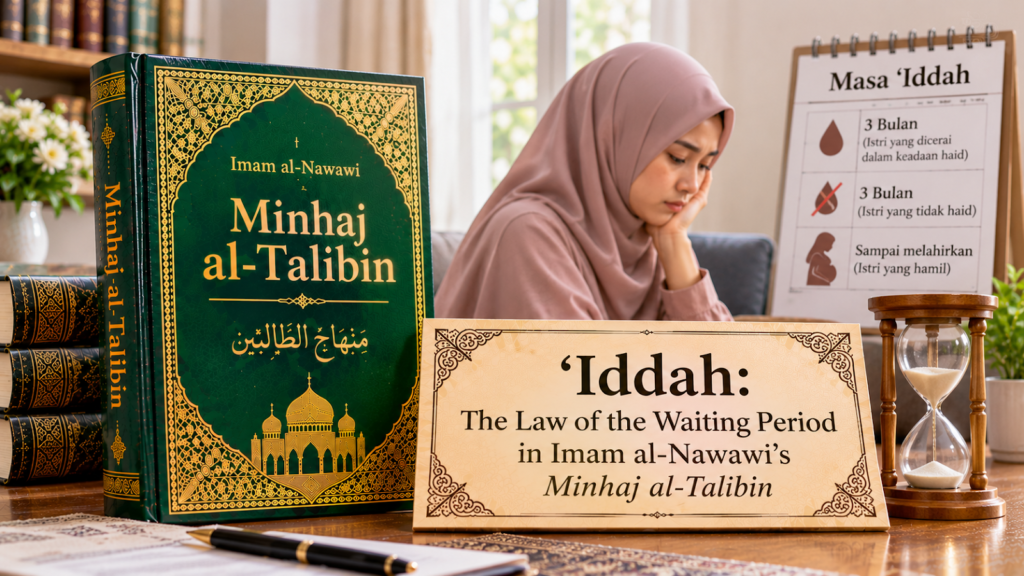
‘Iddah: The Law of the Waiting Period in Imam al-Nawawi’s Minhaj al-Talibin
Part 3: Family Law (Munakahat) – Waiting period (‘Iddah)
Part of a series on the structure of Minhaj al-Talibin, the classical Shafi’i legal manual. Section 7 of Part 3 (Family Law).
Introduction
After the Book of Mutual Imprecation, Imam al-Nawawi (631–676 AH / 1233–1277 CE) presents the Book of the Waiting Period (Kitab al-‘Iddah). The word ‘iddah comes from the root meaning to count, and in the legal sense it refers to the period that a woman must observe after her marriage has ended, by divorce or by the death of her husband, before she is free to marry someone else. During this time, she may not marry, and she observes certain restrictions, depending on the circumstances.
The institution rests on clear Qur’anic provisions. The chapter of the Cow states that divorced women are to wait for three periods, and that widows are to wait for four months and ten days. The chapter of Divorce adds provisions for women who are pregnant and for those who do not menstruate. The scholars identify several purposes. The waiting period confirms whether the woman is pregnant, thereby protecting the lineage of any child. It allows time for reflection and possible reconciliation after a revocable divorce. And in the case of death, it honors the marriage and gives space for mourning. This article follows the main themes of the book in the general order of the Minhaj.
1. When the waiting period applies
The book states that the waiting period is required in two main situations: separation after the marriage has been consummated, and the death of the husband, whether or not the marriage was consummated. A woman who is divorced before consummation has no waiting period, as the Qur’an states in the chapter of the Confederates. In the case of a husband’s death, the waiting period applies even if he had not yet had relations with her, since it is also a matter of respect for the marriage. The school also applies the waiting period to a woman who has had relations by mistake, in a situation of mistaken identity, where the same concern for lineage arises.
2. The divorced woman who menstruates
For a woman who is divorced after consummation, and who has regular menstrual cycles, the waiting period is three quru’. The school understands this word to mean periods of purity between menstruations, based on the linguistic and juristic discussion that the book summarizes. This differs from the position of some other schools, which take it to mean the menstrual periods themselves. The practical effect is that the waiting period ends when the woman enters her third menstruation after the divorce. If the divorce is pronounced during a period of purity, the remainder of that period counts as the first. The school gives detailed rules for how this is calculated in different situations.
3. The woman who does not menstruate
If a woman has not yet started to menstruate, or has reached an age at which menstruation has stopped, her waiting period is three lunar months. The Qur’an gives this rule in the chapter of Divorce. If a woman who counts by months begins to menstruate before the three months are over, she switches to the counting by quru’. The book also treats the case of a woman whose cycles have stopped for a reason that is not known, in which the school sets out how long she should wait before relying on months.
4. The pregnant woman
A woman who is pregnant when she is divorced or widowed remains in her waiting period until she gives birth. This is stated in the Qur’an, which says that the term of pregnant women is the delivery of their burden. The waiting period ends only when all the children of the pregnancy have been delivered, in the case of twins. The book also explains that the pregnancy must be attributable to the husband whose waiting period it is, since it is the lineage that the rule is meant to protect.
5. The widow
The waiting period of a widow is four months and ten days, as stated in the chapter of the Cow. It applies whether or not the marriage was consummated, and whether the wife is young or old. If the widow is pregnant, the school holds that her waiting period ends with delivery, even if it takes longer or shorter than four months and ten days. Different rules for a slave woman, with shorter periods, are discussed in the classical sources, though they belong to a social system that no longer has legal force.
6. Revocable and irrevocable divorce
The book distinguishes between the waiting period after a revocable divorce, which was discussed in the Book of Divorce, and the waiting period after a final one. During a revocable waiting period, the woman remains the husband’s wife in several respects. He may take her back without a new contract, they may inherit from one another, and he must continue to provide her with housing and maintenance. After a final separation, such as by khul’ or the third divorce, the husband has no right to return, and the woman may not be proposed to in direct terms while she is in the waiting period.
7. Housing and maintenance
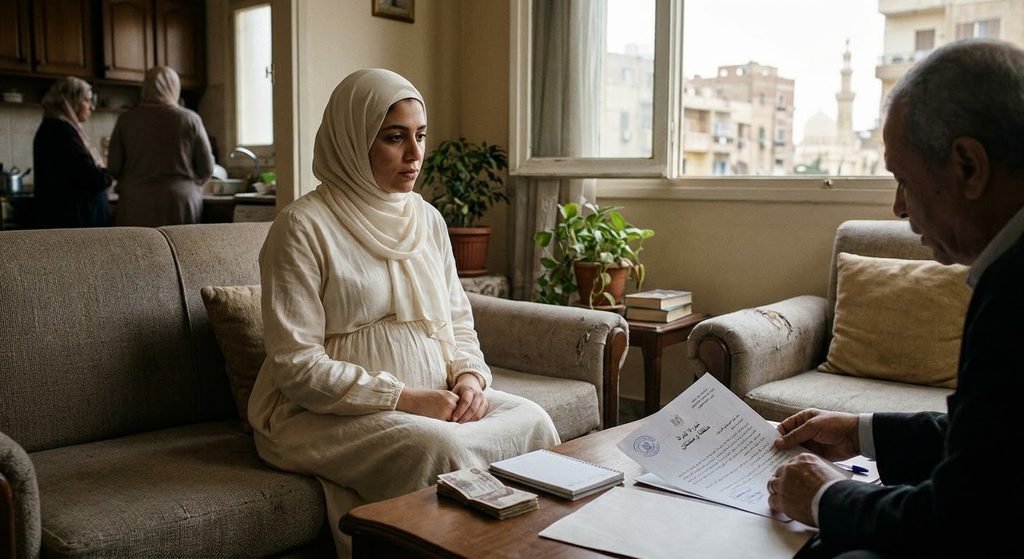
The woman who is in her waiting period has certain rights. The school holds that a woman in a revocable waiting period is entitled to both housing and maintenance, since she is still treated as a wife. A woman in a final waiting period who is pregnant is entitled to both, for the sake of the child. If she is not pregnant, she is entitled to housing but not to maintenance, in the school’s relied-upon position. The widow’s housing and maintenance are discussed separately, with attention to the fact that the husband’s estate has passed to the heirs.
The woman is expected to stay in the marital home during the waiting period, and she may leave it only for a need, such as buying necessities, or for a valid reason. The Qur’an addresses this in the chapter of Divorce, which instructs husbands not to expel their wives from their homes during this time, and instructs the wives not to leave. The book explains the exceptions, such as danger or the collapse of the house.
8. Mourning (ihdad)
A widow, in addition to waiting, observes a period of mourning. The Prophet taught that a woman should not mourn for the dead for more than three days, except for a husband, for whom she mourns four months and ten days. The school requires the widow to avoid adornment, such as perfume, cosmetics, and conspicuous jewelry or colored clothing. This is obligatory for the widow and not for the divorced woman, according to the school’s position. The book explains what is permitted, such as ordinary clean clothing and necessary hygiene.
9. The woman whose husband is missing
The book treats the case of a woman whose husband has disappeared. The school’s relied-upon position is that she remains married to him until his death is established by evidence or by a ruling of the judge, and that she should wait. Only then does the waiting period of a widow begin. Other schools have allowed her to apply to the judge after a defined period, and later practice in many places followed those solutions. The Minhaj presents the school’s established rule, and commentaries record the discussion.
10. Related matters
The book deals with overlapping waiting periods, such as when a woman who is in the waiting period after one marriage is mistakenly married to another man, and with the waiting period after the annulment of a marriage. It also includes a section on verifying that a woman is free of pregnancy (istibra’), which in its classical context concerned the acquisition of a female slave. That context has no present legal application, since slavery is abolished.
Why the order matters
The book follows the logic of the Qur’anic provisions. It begins with the cases, divorced women, then women who do not menstruate, pregnant women, and widows. It then covers the rights and duties during the period, and ends with special cases. This order helps the student to learn the periods first, which is the main legal question, and then the consequences. It reflects the dual character of the institution: a protection of lineage and a recognition of the marriage’s significance.
Closing reflection
For al-Nawawi, the waiting period is a form of respect for a bond that has been ended. It protects the child who may be on the way, gives the spouses a final chance to reconsider in a revocable divorce, and gives a widow the space to mourn. The detail of the counting should not hide the purpose, which is to ensure that the end of one marriage and the start of another are clear, orderly, and free of doubt.
Note: This article summarizes the general Shafi’i position as presented in Minhaj al-Talibin. Details, including the meaning of quru’ and the entitlements during the waiting period, differ among the schools and can vary between editions and commentaries. Family matters are also regulated by national laws, so readers who need a precise ruling should consult a qualified teacher or scholar.