

Sulh: The Law of Settlement in Imam al-Nawawi’s Minhaj al-Talibin
Part 2: Transactions (Mu’amalat) – Settlement (Sulh)
Part of a series on the structure of Minhaj al-Talibin, the classical Shafi’i legal manual. Section 4 of Part 2 (Transactions).
Introduction
After the Book of Insolvency and Restriction, Imam al-Nawawi (631–676 AH / 1233–1277 CE) presents the Book of Settlement (Kitab al-Sulh). The word sulh means making peace, and in legal usage it refers to a contract by which a dispute is resolved by agreement, usually with each side giving up part of its claim. It is the legal form of reconciliation, and it lets people end a conflict without a judgment.
The tradition holds this contract in high regard. The Qur’an says that reconciliation is better, and the Prophet is reported to have said that settlement is permitted among Muslims, except a settlement that makes the lawful unlawful or the unlawful lawful. The book builds on this principle. This article follows its main themes in the general order of the Minhaj.
1. Settlement after an admission
The first case the book addresses is the one in which the defendant admits the claim, but the parties agree on a resolution by negotiation. Al-Nawawi explains that in this case the settlement is valid, and its legal character depends on what is exchanged:
- If the claimant accepts part of what he is owed, and waives the rest, the settlement is treated as a partial gift (hibah) of the remainder and a receipt of the part.
- If the claimant accepts something different in place of the claim, the settlement is treated as a sale, and the rules of sale apply, including those about the exchange of goods and the prohibition of usury.
- If the claimant accepts a benefit, such as the use of a house for a period, in place of the claim, the contract is treated as a lease, and the rules of leasing apply.
This principle is characteristic of the school. A settlement is not a separate legal kind with its own rules, but takes the rules of the contract that it resembles. This keeps the law consistent and provides a ready method for deciding questions of validity.
2. Settlement in the face of denial
The more debated case is settlement when the defendant denies the claim, or does not answer. In the Shafi’i position, as presented in the Minhaj, such a settlement is not valid, because the claim remains unproven, and an exchange based on a disputed obligation risks making lawful what is unlawful, or the opposite. The book explains the reasoning: if the claimant is truthful, he has given up part of his right, and if the defendant is truthful, then the claimant has taken what is not his.
The school points out that this does not prevent a person from paying to end a dispute. A defendant may pay a sum, or a claimant may waive part of his claim, in a way that is treated as a separate valid act, such as a gift or a payment to protect oneself from trouble. Other schools treat settlement upon denial as valid, which makes this one of the best-known points of difference.
3. Conditions of a valid settlement
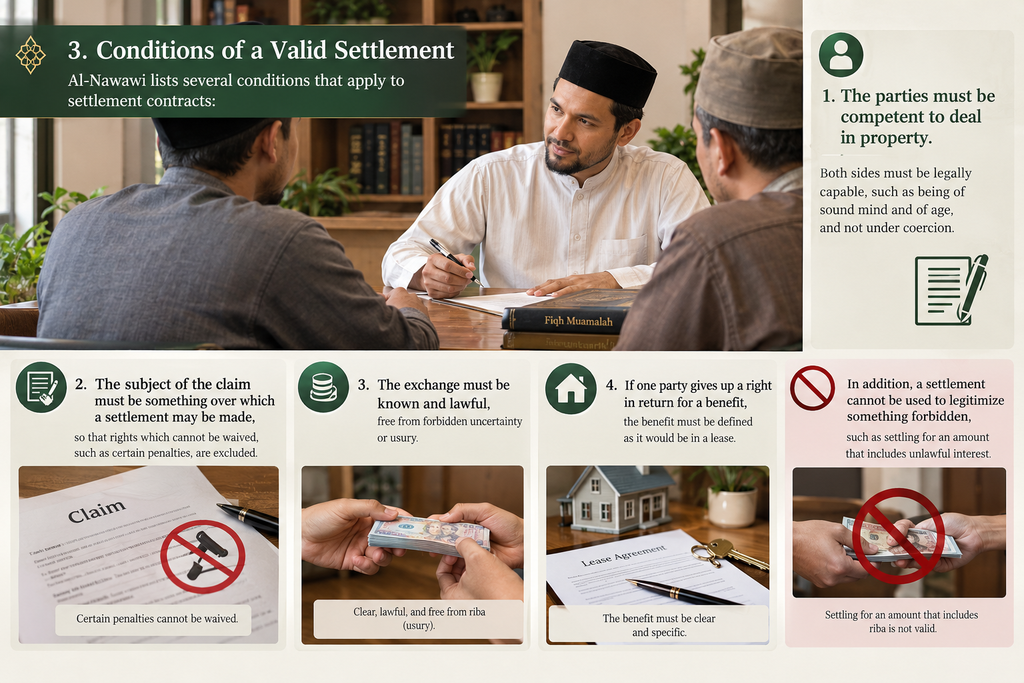
Al-Nawawi lists several conditions that apply to settlement contracts:
- The parties must be competent to deal in property.
- The subject of the claim must be something over which a settlement may be made, so that rights which cannot be waived, such as certain penalties, are excluded.
- The exchange must be known and lawful, free from forbidden uncertainty or usury.
- If one party gives up a right in return for a benefit, the benefit must be defined as it would be in a lease.
In addition, a settlement cannot be used to legitimize something forbidden, such as settling for an amount that includes unlawful interest.
4. Using the public road
The book then moves to a related topic: the rights of neighbors and the public regarding roads and buildings. A public road is for passage, and individuals may not take it for private use in a way that harms those passing through. Al-Nawawi explains that extending a balcony or a projecting structure into the road is permitted only if it does not obstruct passage and does not cause harm, and where it does, the matter falls to the judge or those with authority.
The school also treats the dead-end lane (darb ghayr nafidh), whose ownership is shared among those who live along it. A resident may not make changes that harm the others, such as opening a new door deeper into the lane, without their agreement, though the school makes distinctions depending on where the door is placed.
5. Walls, beams, and neighbors
Another section covers shared walls and the placement of beams. The tradition records a saying of the Prophet that a neighbor should not prevent his neighbor from setting a beam on his wall. The school discusses how this applies: a neighbor may be asked and may agree to allow it, and the agreement may be formalized as a lease, a loan, or a settlement, with different consequences for each. The book also discusses what happens when the wall collapses or is rebuilt, and who bears the cost.
The general principle is expressed in the well-known legal maxim that there is to be neither harm nor reciprocating harm. Each neighbor may use his own property, but not in a way that causes serious injury to the other.
6. Rights of passage and of water
The book also touches on rights of way and water channels. A person may hold a right to pass through another’s land, or to draw water through it, by agreement or by established practice. Al-Nawawi explains how such rights are created, how they can be assigned or inherited, and how their extent is fixed. Where a right has been granted, the owner of the land may not obstruct it, though he retains the ownership of the ground.
7. Settlement among heirs and in other claims
The principle of settlement extends to other situations, such as heirs reaching an agreement on how to divide an estate, or two parties compromising a doubtful claim. The book notes that the same conditions apply: knowledge of what is being exchanged, absence of coercion, and lawful terms.
Why the order matters
The book begins with the general contract of settlement and its legal characterization, then moves to the controversial case of settlement under denial, and finally to practical matters of neighborly rights. This order moves from principle to application. A reader sees first how the law handles agreements to end disputes, and then how it prevents disputes between neighbors from arising in the first place.
Closing reflection
For al-Nawawi, settlement is a path toward peace and one of the more humane parts of the law of transactions. The legal precision reflects a concern that peace should not be built on injustice: a reconciliation is welcome, as long as it does not turn the forbidden into the permitted. The sections on neighbors carry the same ethic into daily life, where good neighborliness is a matter of both law and character.
Note: This article summarizes the general Shafi’i position as presented in Minhaj al-Talibin. Details, including the ruling on settlement under denial, differ among the schools and can vary between editions and commentaries. Readers who need a precise ruling should consult a qualified teacher or scholar.