
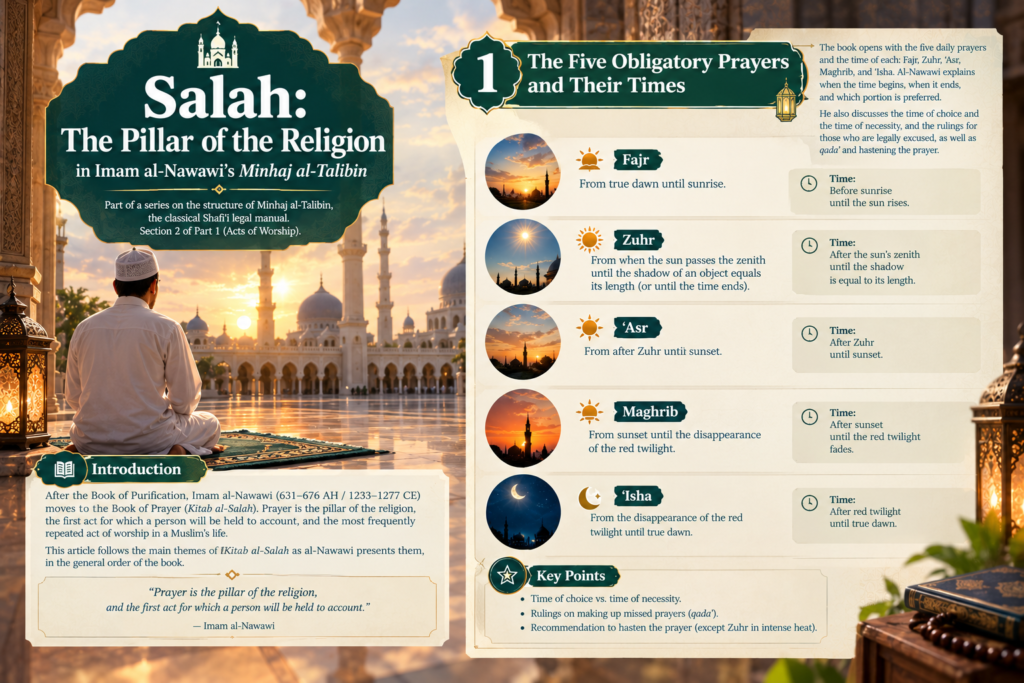
Salah: The Pillar of the Religion in Imam al-Nawawi’s Minhaj al-Talibin
Part 1: Acts of Worship (Ibadat) – Prayer (Salah)
Part 1: Acts of Worship (Ibadat) – Prayer (Salah)
Part of a series on the structure of Minhaj al-Talibin, the classical Shafi’i legal manual. Section 2 of Part 1 (Acts of Worship).
Introduction
After the Book of Purification, Imam al-Nawawi (631–676 AH / 1233–1277 CE) moves to the Book of Prayer (Kitab al-Salah). The order is intentional. Purification is the key, and prayer is what it opens. In the prophetic tradition, prayer is described as the pillar of the religion and the first act for which a person will be held to account. It is also the most frequently repeated act of worship in a Muslim’s life, which explains why the jurists devoted so much attention to its details.
This article follows the main themes of Kitab al-Salah as al-Nawawi presents them, in the general order of the book.
1. The five obligatory prayers and their times
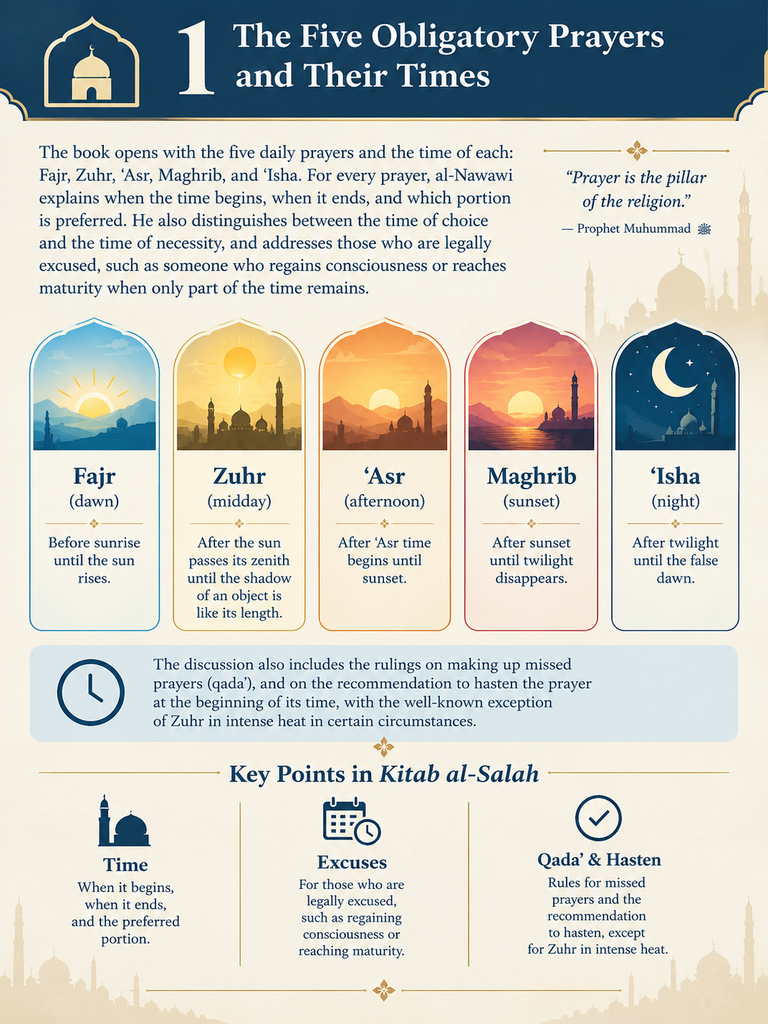
The book opens with the five daily prayers and the time of each: Fajr, Zuhr, ‘Asr, Maghrib, and ‘Isha. For every prayer, al-Nawawi explains when the time begins, when it ends, and which portion is preferred. He also distinguishes between the time of choice and the time of necessity, and addresses those who are legally excused, such as someone who regains consciousness or reaches maturity when only part of the time remains.
The discussion also includes the rulings on making up missed prayers (qada’) and on the recommendation to hasten the prayer at the beginning of its time, with the well-known exception of Zuhr in intense heat in certain circumstances.
2. The call to prayer and the second call
The adhan (call to prayer) and the iqamah (the call announcing that the prayer is about to begin) are treated next. In the Shafi’i school, both are emphasized as a confirmed sunnah for the obligatory prayers, rather than obligations on each individual. The book covers the wording, the conditions of the caller (mu’adhdhin), the recommendation of a pleasant and strong voice, and the response of the listener.
3. Facing the qiblah
Facing the Ka’bah is a condition for the validity of prayer. Al-Nawawi explains the obligation for someone who can see the Ka’bah and for someone who is far from it, where the requirement is to face its direction through effort and reasoning (ijtihad). He also lists the exceptions: the person in a state of intense fear, and the traveler praying a voluntary prayer on a mount, who may pray in the direction of travel.
4. The conditions of prayer
Before the prayer is performed, several conditions (shurut) must be met. The main ones are:
- Knowing that the time has entered.
- Being free of both major and minor ritual impurity.
- Being free of physical impurity on the body, clothing, and place of prayer.
- Covering the ‘awrah. The limits differ for men and women, and between free women and others.
- Facing the qiblah.
The connection with the previous book is clear here: the whole Book of Purification serves these conditions.
5. The pillars of prayer
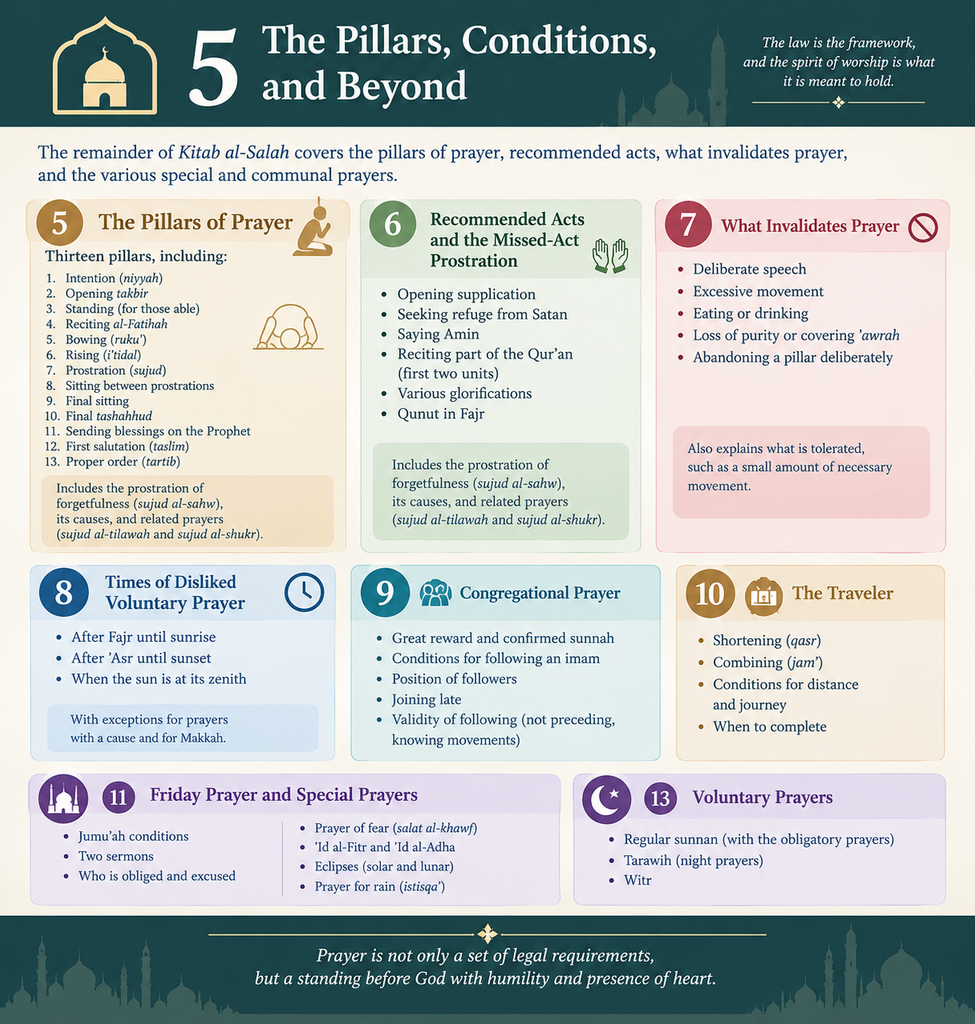
The core of the book is the list of pillars (arkan) without which a prayer is invalid. Al-Nawawi counts thirteen in his presentation, with the tranquility (tuma’ninah) required within the relevant actions. Other Shafi’i works may enumerate them with slightly different groupings. In summary, they are:
- The intention (niyyah).
- The opening takbir (takbirat al-ihram).
- Standing, for the one who is able, in the obligatory prayer.
- Reciting al-Fatihah.
- Bowing (ruku’).
- Rising from the bow and standing upright (i’tidal).
- Prostration (sujud), twice in each unit.
- Sitting between the two prostrations.
- The final sitting.
- The final tashahhud.
- Sending blessings upon the Prophet in the final tashahhud.
- The first salutation (taslim).
- Performing the acts in their proper order (tartib).
The Shafi’i position that reciting al-Fatihah is a pillar in every unit, including for the follower behind an imam in the audible prayers according to the school’s well-known view, is one of the points on which the school is most readily identified.
6. Recommended acts and the missed-act prostration
Al-Nawawi distinguishes between pillars and sunan. Among the sunan are the opening supplication, seeking refuge from Satan, saying Amin, reciting a portion of the Qur’an after al-Fatihah in the first two units, the various glorifications, and the qunut in the Fajr prayer. The school further separates the more emphasized sunan (abʻad), whose omission is compensated for by a prostration of forgetfulness, from the lesser ones.
That prostration of forgetfulness (sujud al-sahw) is itself treated in detail: its causes, its timing before the final salutation, and the rulings for the follower and for someone who doubts the number of units. A related topic is the prostration of Qur’anic recitation (sujud al-tilawah) and the prostration of gratitude (sujud al-shukr).
7. What invalidates the prayer
The book lists the things that nullify prayer: deliberate speech, excessive and continuous movement, eating or drinking, the loss of a condition such as purity or the covering of the ‘awrah, and abandoning a pillar deliberately. It also explains what is tolerated, such as a small amount of necessary movement.
8. Times in which voluntary prayer is disliked
Al-Nawawi addresses the periods during which prayer without a cause is disliked, such as after the Fajr and ‘Asr prayers until the following sunrise and sunset respectively, and when the sun is at its zenith, with the well-known exceptions the school makes for prayers that have a reason and for Makkah.
9. Congregational prayer
Prayer in congregation (jama’ah) carries great reward. In the Shafi’i school it is a confirmed sunnah, and the book explains the conditions of following an imam, who is more entitled to lead, the position of the followers, and the rulings for someone who joins late. It also covers the conditions for the validity of following the imam, such as not preceding him and knowing his movements.
10. Prayer of the traveler
A traveler may shorten the four-unit prayers to two (qasr) and may combine Zuhr with ‘Asr and Maghrib with ‘Isha (jam’), subject to conditions regarding the distance and permissibility of the journey, which the book details. The same chapter explains when a traveler must complete the prayer.
11. The Friday prayer
The Friday prayer (Jumu’ah) has its own conditions in the school, including the settled residence of the congregation, a minimum number of attendees, the performance within the time of Zuhr, and the two sermons that precede it. Al-Nawawi explains who is obliged to attend and who is excused.
12. Special prayers
The book then covers prayers connected with particular situations: the prayer in a state of fear (salat al-khawf), the two festival prayers (‘Id al-Fitr and ‘Id al-Adha) with their takbirs and sermon, the prayer of the solar and lunar eclipses, and the prayer for rain (istisqa’). Each has its own manner of performance, which al-Nawawi summarizes concisely.
13. Voluntary prayers
The jurists also discuss the voluntary prayers, including the regular sunan accompanying the obligatory prayers, the night prayers such as Tarawih in Ramadan, and Witr. These are the means by which a worshipper compensates for shortcomings in the obligatory acts and draws nearer to God.
Why the order matters
The structure of Kitab al-Salah moves naturally from preconditions to performance to exceptions. It begins with time, calls, direction, and conditions, which prepare the worshipper. It then describes the prayer itself with its pillars and recommended acts, and addresses what can go wrong and how to repair it. Finally, it expands outward to the communal, travel-related, and occasional prayers. A student who understands this sequence can follow the logic of the whole book instead of memorizing isolated rulings.
Closing reflection
For al-Nawawi, prayer is not only a set of legal requirements. The precision of the pillars and conditions exists to protect something deeper: the worshipper’s standing before God with humility and presence of heart. The law is the framework, and the spirit of worship is what it is meant to hold.
Note: This article summarizes the general Shafi’i position as presented in Minhaj al-Talibin. The ordering of chapters, the grouping of pillars, and finer details can vary between editions and commentaries, so readers who need a precise ruling should consult a qualified teacher or the standard commentaries.