
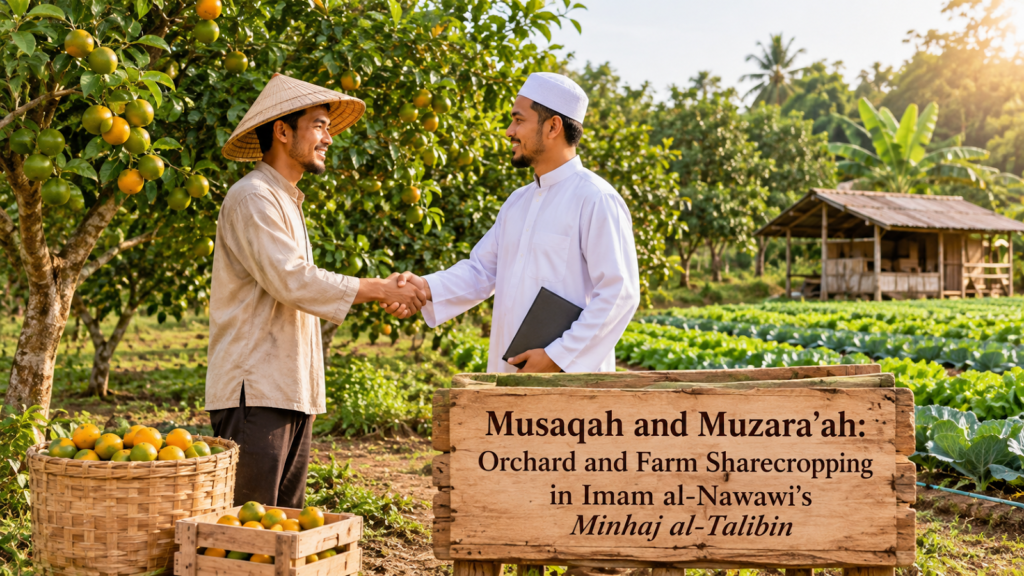
Musaqah and Muzara’ah: Orchard and Farm Sharecropping in Imam al-Nawawi’s Minhaj al-Talibin
Part 2: Transactions (Mu’amalat) – Sharecropping and tenant farming (Musaqah and Muzara’ah)
Part of a series on the structure of Minhaj al-Talibin, the classical Shafi’i legal manual. Section 14 of Part 2 (Transactions).
Introduction
After the Book of Profit-Sharing Investment, Imam al-Nawawi (631–676 AH / 1233–1277 CE) presents the Book of Orchard Sharecropping and Farm Sharecropping (Kitab al-Musaqah wa al-Muzara’ah). These are contracts that allow a landowner to have his trees or fields cultivated by a worker, who is paid with a share of the harvest instead of a fixed wage. The first, musaqah, concerns trees, whose name derives from the watering that is their main labor. The second, muzara’ah, concerns the sowing of land.
The contracts are rooted in agricultural life. Many landowners lack the time or labor to tend their orchards, while many workers have skill and strength but no land. The law provides a way for the two to cooperate. The main source is the report of Khaybar, in which the Prophet is related to have given the land and palm groves of Khaybar to its inhabitants to work, in return for half of the produce. This article follows the main themes of the book in the general order of the Minhaj.
1. Musaqah: the contract for trees
Musaqah is a contract in which the owner of a tree gives it to a worker to tend and irrigate, and the two share the fruit in an agreed proportion. In the Shafi’i school, as presented in the Minhaj, the contract is valid for date palms and grapevines. The school extends it no further in this work, since the report that supports it concerns these trees and since their fruit is easily estimated, which limits uncertainty. Other trees are generally treated by way of a lease, or another contract.
2. The conditions of musaqah
The book states several conditions for a valid contract:
- Wording: an offer and acceptance that express the contract, such as “I have given you this orchard to tend for half of its fruit.”
- The trees: they must be known and specified, and must be established in the ground, not young shoots that do not yet bear.
- The time: the contract must have a known duration, long enough for the trees to produce fruit. An unlimited term is not valid, since it creates uncertainty.
- The share: the worker’s share must be a known fraction of the fruit, such as a half or a third. A fixed amount, or a stipulation that one party takes all the fruit, makes the contract void.
- The work: the worker takes on the continuing labor, and the owner has no claim to labor from the worker beyond what the contract defines.
The school also addresses the requirement that the contract be made before the fruit has ripened. After the fruit is ready, the worker’s labor has little effect, and the arrangement becomes closer to a sale of fruit for wages.
3. The division of tasks
The book explains which tasks belong to the worker and which to the owner. The worker is responsible for the labor that recurs each year and is necessary for the tree’s fruit, including irrigation, pruning, pollination, weeding, guarding the crop, and picking. The owner is responsible for the fixed and capital expenses, such as digging a well, building a wall, and providing the means of irrigation. This division follows custom, and the parties may specify further details. A stipulation that shifts to the worker the owner’s duties, or the reverse, may invalidate the contract.
4. The nature of the contract and its ending
In the Shafi’i school, musaqah is a binding contract, in contrast to profit-sharing investment, which is permitted and revocable at will. This is because the worker’s labor builds up gradually, and sudden termination would harm him. The contract ends when its term expires, or by mutual agreement. The worker’s death does not end the contract automatically, and the heirs may continue his work or appoint someone to do so. If the worker abandons the work, or proves to be dishonest, the owner may go to the court to require performance or to cancel the contract, with the usual consideration for the worker’s wage.
The book also treats the case in which the trees fail to bear fruit. The worker receives nothing for his work, since his reward is tied to the fruit, which is the nature of this contract, a sharing of both risk and gain.
5. Muzara’ah: the contract for planting
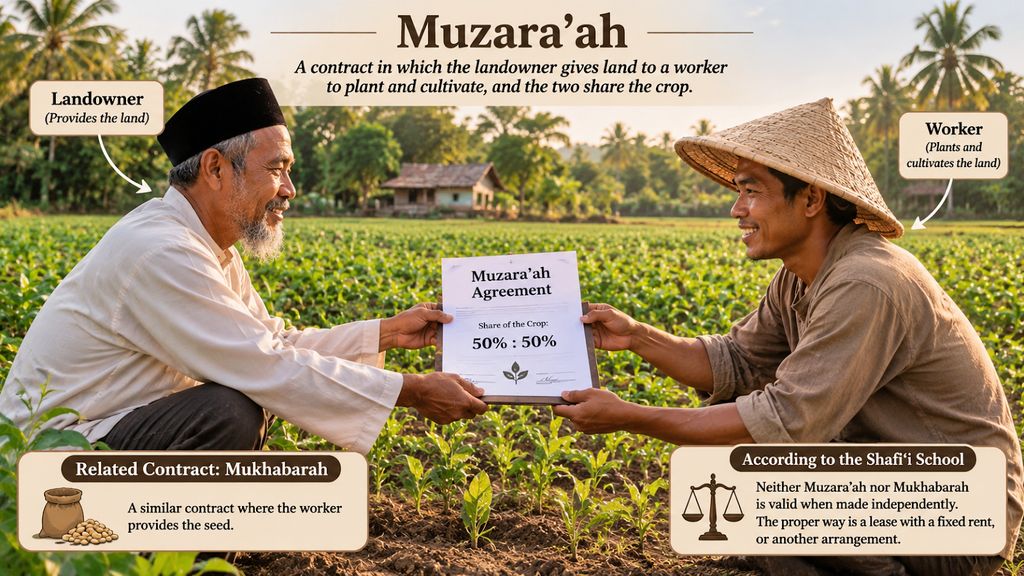
Muzara’ah is a contract in which the landowner gives land to a worker to plant and cultivate, and the two share the crop. A related form, known as mukhabarah, is one in which the worker supplies the seed. In the Shafi’i school, as presented in the Minhaj, neither contract is valid when made independently. The school relies on a report in which the Companion Rafi’ ibn Khadij related that the Prophet forbade certain arrangements for renting land by a share of what particular plots would produce, because of the uncertainty and the disputes that it caused. The school therefore holds that land may be leased for a fixed rent, in money or in goods, and that the proper way for an owner to receive a share of the produce is through a lease with a fixed payment or through a different arrangement.
6. The exception for land between trees
The school makes an important exception. If an orchard contains open land between the trees, and it is small in relation to the trees and hard to irrigate separately, then a muzara’ah contract may be added to the musaqah on the same terms, as an incidental part of the main contract. The book requires that the two be made together in one contract, and that the worker’s task on the open land be the same as on the trees. This exception recognizes that, in such a case, the open land cannot sensibly be handled apart from the orchard.
7. The scholarly discussion
This is one of the points on which the schools differ most. Many scholars of other schools allow muzara’ah and mukhabarah as independent contracts, relying on the Khaybar report, which they understand to include both trees and land. Within the Shafi’i school, later scholars discussed the matter at length, and some, including al-Nawawi in his other works, are reported to have leaned toward wider permission on the strength of the evidence. The Minhaj presents the school’s established position, and readers who need to rely on a ruling should note that commentaries and later works record this discussion.
8. Disputes
The final section of the book deals with disputes. The parties may disagree about the share that was agreed, the term, or whether the worker fulfilled his duties. The school applies its usual rules: each party swears in turn, and the contract may be dissolved if the disagreement concerns the essential terms. If the worker is accused of negligence or theft of the fruit, he is a trustee, and his word is accepted regarding loss unless evidence shows otherwise.
Why the order matters
The book begins with musaqah, the contract that is clearly valid, and sets out its conditions, its division of tasks, and its nature. It then turns to muzara’ah, which the school treats more restrictively, and ends with the exception that connects the two. This order follows the logic of the school’s position: first the contract with direct textual support, then the related contract that is allowed only in a limited form, and finally the point where they meet. It lets the student see not only the rules but also the reasoning behind them.
Closing reflection
For al-Nawawi, these contracts reflect the law’s concern that agricultural partnerships be clear and fair. The worker’s share is tied to the fruit, which gives him a stake in the result, and the strict conditions protect against the disputes that arise when the share or the work is vague. The restrictive position on independent muzara’ah shows how seriously the school takes the avoidance of uncertainty, while the exception for land between trees shows that it also respects practical realities.
Note: This article summarizes the general Shafi’i position as presented in Minhaj al-Talibin. The validity of muzara’ah and of musaqah on trees other than palms and vines is among the most discussed differences between the schools and within the Shafi’i school itself, and details can vary between editions and commentaries. Readers who need a precise ruling should consult a qualified teacher or scholar.