
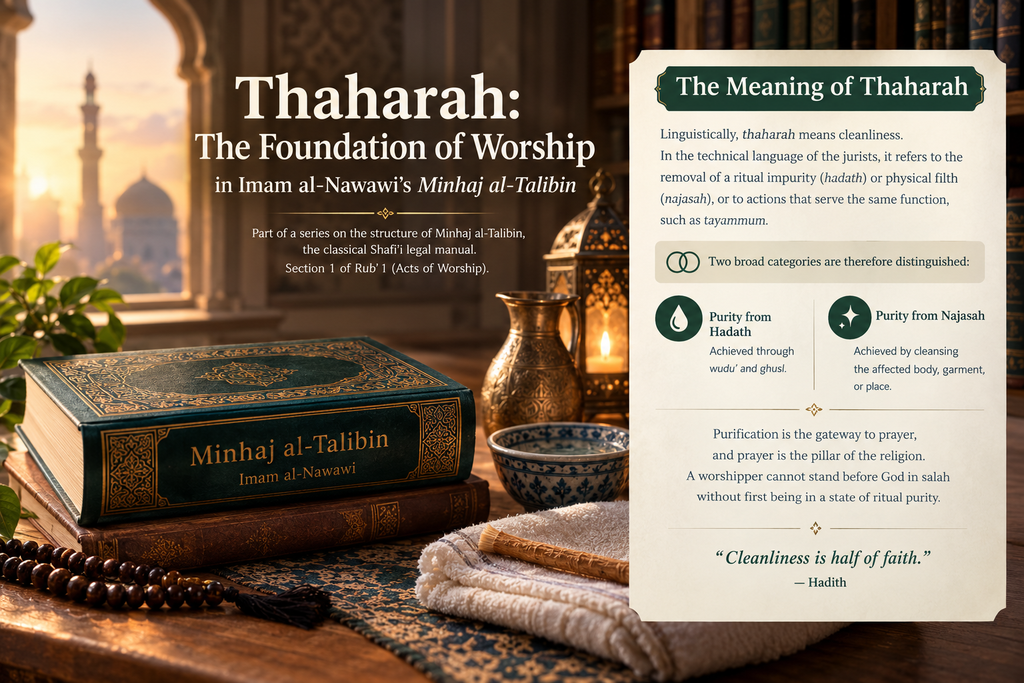
Thaharah: The Foundation of Worship in Imam al-Nawawi’s Minhaj al-Talibin
Part 1: Acts of Worship (Ibadat) – Purification (Taharah)
Part of a series on the structure of Minhaj al-Talibin, the classical Shafi’i legal manual. Section 1 of Rub’ 1 (Acts of Worship).
Introduction
Imam Yahya ibn Sharaf al-Nawawi (631–676 AH / 1233–1277 CE) is among the most influential scholars of the Shafi’i school. His Minhaj al-Talibin wa ‘Umdat al-Muftin is a concise legal manual that has been studied, memorized, and commented upon for centuries. Like most classical works of fiqh, it opens with the Book of Purification (Kitab al-Thaharah). The placement is deliberate: purification is the gateway to prayer, and prayer is the pillar of the religion. A worshipper cannot stand before God in salah without first being in a state of ritual purity.
This article walks through the main topics that al-Nawawi covers in this opening book, in the order in which he presents them.
The meaning of thaharah
Linguistically, thaharah means cleanliness. In the technical language of the jurists, it refers to the removal of a ritual impurity (hadath) or physical filth (najasah), or to actions that serve the same function, such as tayammum. Two broad categories are therefore distinguished: purity from hadath, which is achieved through wudu’ and ghusl, and purity from najasah, which is achieved by cleansing the affected body, garment, or place.
1. Water: the primary means of purification
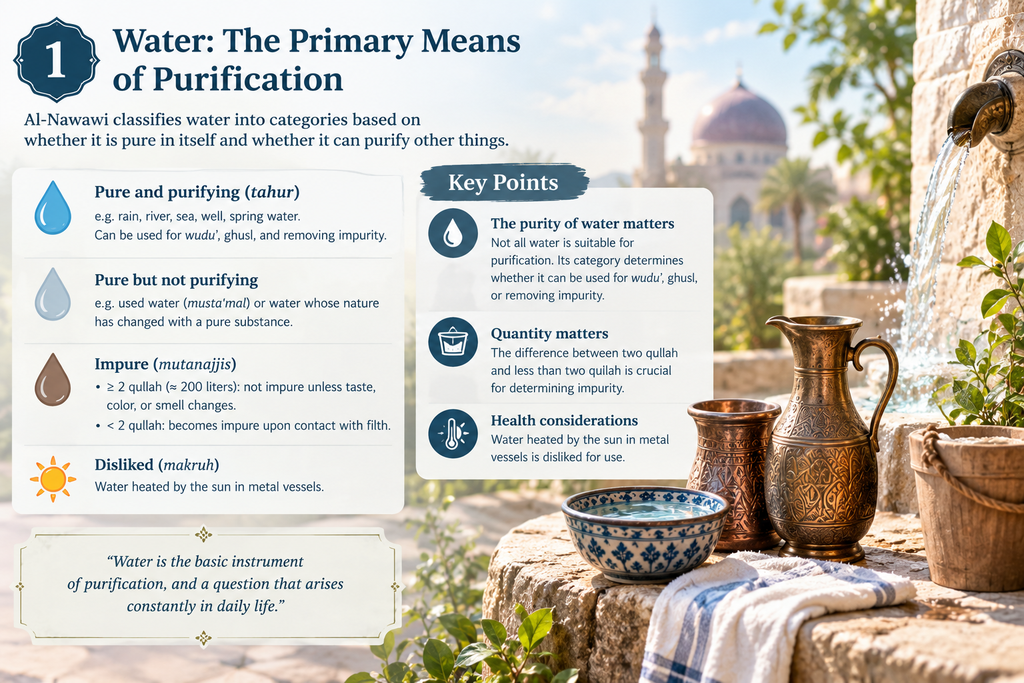
The book begins with water, because water is the basic instrument of purification. Al-Nawawi classifies water into categories according to whether it is pure in itself and whether it can purify other things:
- Pure and purifying (tahur): absolute water (ma’ mutlaq), such as rain, river, sea, well, and spring water. It may be used for wudu’, ghusl, and removing impurity.
- Pure but not purifying: water that has already been used to remove a hadath or najasah (musta’mal), or water whose nature has been changed by a pure substance mixed into it to the point that it can no longer be called simply “water.”
- Impure (mutanajjis): water that has come into contact with impurity. Here the school distinguishes between a large and a small quantity. Water that reaches two qullah (commonly estimated at roughly 200 liters, with scholars giving slightly different figures) is not rendered impure by contact with filth unless its taste, color, or smell changes. Less than two qullah becomes impure upon contact with filth, even if no change is visible.
- Disliked (makruh) for use: water heated by the sun in metal vessels is mentioned as disliked in the school, for reasons connected to health.
This classification gives the student a framework for deciding whether a given water is fit for purification, a question that arises constantly in daily life.
2. Vessels
After water, al-Nawawi turns to the containers in which water is kept. Vessels of gold and silver are prohibited for eating, drinking, and purification, for men and women alike. Other vessels, including those made of precious stones, are permissible. The discussion also covers the use of the skins of animals and the question of which hides become pure through tanning.
3. The siwak
The siwak (tooth-stick) is treated as a recommended practice. It is particularly emphasized at the time of wudu’, before prayer, upon waking, and when the mouth changes in smell. The inclusion of this small topic within the book of purification shows how the tradition links ritual purity with personal cleanliness.
4. Wudu’ (ablution)
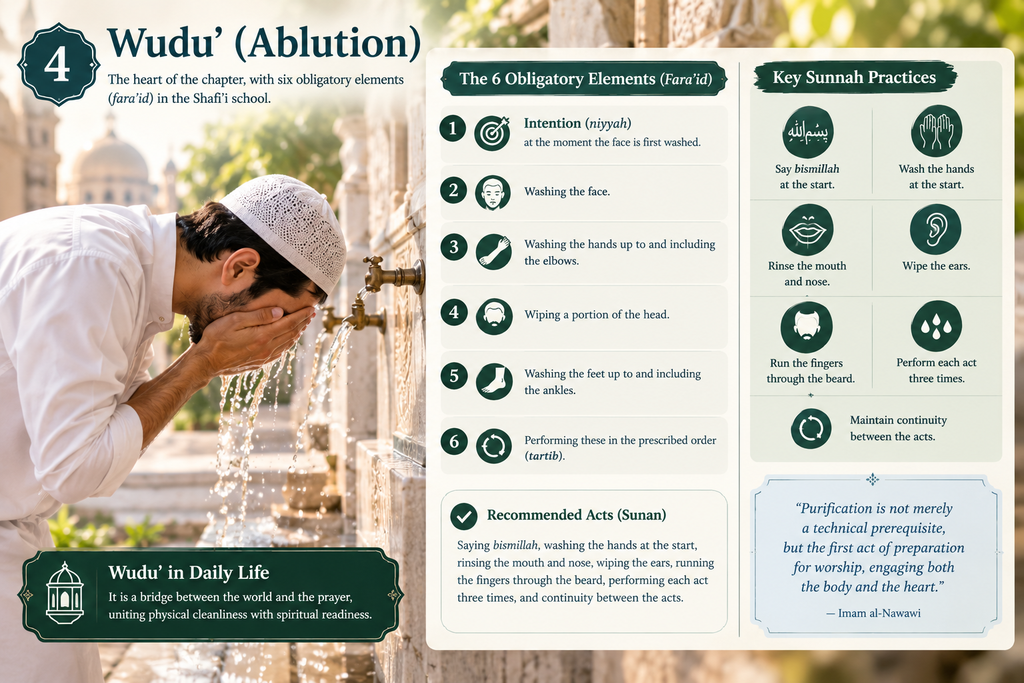
The heart of the chapter is the discussion of wudu’. Following the Qur’anic verse on ablution (al-Ma’idah 5:6), the Shafi’i school identifies six obligatory elements (fara’id):
- The intention (niyyah) at the moment the face is first washed.
- Washing the face.
- Washing the hands up to and including the elbows.
- Wiping a portion of the head.
- Washing the feet up to and including the ankles.
- Performing these in the prescribed order (tartib).
Beyond these essentials, al-Nawawi lists the recommended acts (sunan) of wudu’, such as saying bismillah, washing the hands at the start, rinsing the mouth and nose, wiping the ears, running the fingers through the beard, performing each act three times, and continuity between the acts.
5. Istinja’ and the etiquette of relieving oneself
The book then addresses the etiquette of the toilet and istinja’, the cleansing of the private parts after urination or defecation. It discusses the use of water, stones, or other suitable materials, and the manners that accompany the act, including the supplications and the avoidance of facing or turning one’s back to the qiblah in open spaces.
6. What nullifies wudu’
Al-Nawawi then lists the things that invalidate wudu’ in the Shafi’i school:
- Anything that exits from the front or rear passage.
- Loss of consciousness through sleep (except sleeping while firmly seated), unconsciousness, or loss of reason.
- Direct skin contact between a man and a woman who are not related as mahram.
- Touching the private part of a human being with the palm of the hand.
The Shafi’i position on the third and fourth items is one of the distinctive features of the school, and it is a classic point of comparison with the other schools.
7. Ghusl (the full bath)
The obligation of ghusl arises from several causes: the meeting of the two private parts, emission of semen, menstruation, postnatal bleeding, childbirth, and death (in the case of a Muslim who is not a martyr in battle). The obligatory elements of ghusl are the intention and the washing of the entire body, including the hair and skin. Al-Nawawi also lists its recommended practices and the prayers and acts that are forbidden for a person in a state of major impurity, such as praying, circumambulating the Ka’bah, touching or carrying the mushaf, and reciting the Qur’an.
8. Wiping over the leather socks (mash ‘ala al-khuffayn)
In place of washing the feet, one may wipe over leather socks (khuff) under conditions the book sets out: they were put on while in a state of purity, they cover the parts of the foot that must be washed, and they are sturdy enough for walking. The permitted duration is one day and one night for the resident, and three days and nights for the traveler.
9. Najasah (physical impurity)
The book defines what counts as impure, including urine, feces, blood, pus, wine, carrion, and dogs and pigs, and explains how impurities are removed. In general, removing an impurity whose trace is visible requires eliminating the trace, while an impurity with no visible trace is removed by pouring water over it. A special method is described for impurity from a dog or a pig, which involves washing seven times, one of them with earth.
10. Tayammum (dry ablution)
When water is unavailable, or its use would cause harm through illness, the Qur’an permits tayammum with pure earth. Al-Nawawi explains its conditions, its obligatory elements (the intention, wiping the face, and wiping the hands to the elbows, with two strikes on the earth), and what invalidates it.
11. Menstruation, postnatal bleeding, and irregular bleeding
The book closes with the rulings on hayd (menstruation), nifas (postnatal bleeding), and istihadah (irregular bleeding). It sets out their minimum and maximum durations, the rulings on a woman’s acts of worship during these states, and how a woman with continuous bleeding should purify herself and pray. This closing section is detailed and technical, and it has long been regarded as one of the more demanding parts of the book.
Why the order matters
The sequence of Kitab al-Thaharah follows a clear logic. It begins with the means of purification (water and vessels), moves to the rituals themselves (wudu’, ghusl, wiping over khuffs), addresses the impurities that must be removed (najasah), offers the alternative when water is unavailable (tayammum), and ends with the special conditions affecting women. A student who masters this single book has the foundation needed to approach the book that follows it, the Book of Prayer.
Closing reflection
For al-Nawawi, purification is not merely a technical prerequisite. It is the first act of preparation for worship, one that engages both the body and the heart. By beginning his manual here, he reminds the reader that the path of fiqh starts with cleanliness, humility, and readiness to stand before God.
Note: This article summarizes the general Shafi’i position as presented in Minhaj al-Talibin. Quantities and fine details can vary between commentaries, so readers who need a precise ruling should consult a qualified teacher or the standard commentaries.