

Ijarah: The Law of Lease and Hire in Imam al-Nawawi’s Minhaj al-Talibin
Part 2: Transactions (Mu’amalat) – Leasing and hire (Ijarah)
Part of a series on the structure of Minhaj al-Talibin, the classical Shafi’i legal manual. Section 15 of Part 2 (Transactions).
Introduction
After the books on sharecropping, Imam al-Nawawi (631–676 AH / 1233–1277 CE) presents the Book of Lease and Hire (Kitab al-Ijarah). In the legal sense, ijarah is a contract for the benefit of something in exchange for a known payment. It covers renting a house, a vehicle, or an animal, and also hiring a person to do a task. In both cases what is sold is not the thing itself but its use or the labor of the worker, which the jurists call manfa’ah, benefit.
The contract is among the most common in daily life, and the tradition supports it strongly. The Qur’an tells the story of the daughter of an elder who said of Moses that he was the best person to hire, being strong and trustworthy. The Prophet is reported to have said that workers should be paid before their sweat dries. This article follows the main themes of the book in the general order of the Minhaj.
1. The pillars of the contract
The book lists the elements of the lease as the wording, the two parties, the payment, and the benefit. As in sale, there must be an offer and acceptance, and the parties must be competent to deal in property. The lessor (mu’jir) and the lessee (musta’jir) must be mature, sane, and acting freely. The contract is described as binding once made, so that neither party can withdraw without cause or agreement.
2. Two types of lease
The school distinguishes two kinds of lease, which has practical consequences:
- Lease of a specific item (‘ayn): the lessee rents a particular thing, such as a house or a named animal. The contract concerns that item, and if it is destroyed, the contract ends for the remaining period.
- Lease of an obligation (dhimmah): the lessor undertakes to provide a benefit that is described but not tied to a particular item, such as transporting goods to a certain place or building a wall of a given type. The lessor must provide the service by any suitable means, and if the means he chooses fails, he must supply another.
This distinction affects what must be specified and what happens when the item is lost.
3. Conditions of the benefit
The benefit being leased must satisfy several conditions:
- It must be lawful and valuable, so a lease for an unlawful purpose, or for something with no real worth, is not valid.
- It must be capable of delivery, so that the lessee can actually use it. Leasing a runaway animal or land with no access is not valid.
- It must be known, defined either by time, such as a house for a year, or by the task, such as carrying a load to a destination.
- It must be a benefit that does not consume the item. Items that are consumed in their use, such as food, cannot be leased.
The school also states that certain obligatory acts of worship, which must be performed by the person himself and require intention, cannot be the subject of a paid lease, while acts that may legally be performed by another, such as certain tasks in the pilgrimage and teaching, are treated separately. The book mentions that teaching the Qur’an for a fee is valid in the school’s relied-upon position, since it is a benefit that can be defined and delivered.
4. The payment
The wage or rent (ujrah) must be known and lawful. It may be money or goods, provided that it is clearly specified. It may also be a benefit of another kind. The school has an important rule on when the wage is due. Ownership of the wage passes to the lessor when the contract is made, but in the position the school relies on, the lessor may demand payment only when he hands over the benefit or completes the work, unless the parties agreed to payment in advance or on a specific schedule. This rule balances the interest of the lessor in being paid with the interest of the lessee in not paying for what he has not yet received.
5. Duration and the leasing of land
A lease of an item for a period must state the duration. The period may be long, as long as the item is expected to last, and the school discusses the limits for different kinds of property. Special conditions apply to leasing land. The lessee must be able to obtain water for the land if it is for planting, and the contract must state what will be planted, or allow any crop that does no more harm to the soil than the one named. These requirements prevent later disputes about what the land may be used for.
6. The lessee’s use and responsibilities
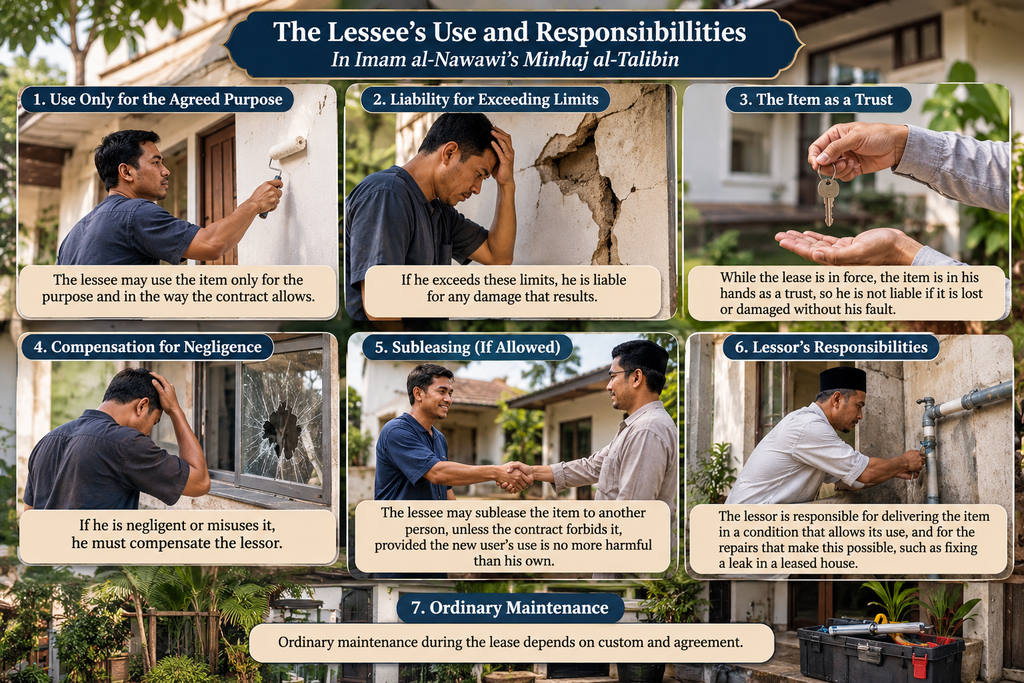
The lessee may use the item only for the purpose and in the way the contract allows. If he exceeds these limits, he is liable for any damage that results. While the lease is in force, the item is in his hands as a trust, so he is not liable if it is lost or damaged without his fault. If he is negligent or misuses it, he must compensate the lessor.
The lessee may sublease the item to another person, unless the contract forbids it, provided the new user’s use is no more harmful than his own. The lessor is responsible for delivering the item in a condition that allows its use, and for the repairs that make this possible, such as fixing a leak in a leased house, while ordinary maintenance during the lease depends on custom and agreement.
7. The hired worker
The book gives special attention to hired workers. There are two kinds. A private worker is hired for a fixed period or for a single employer, and during that time he is available only to him. A public worker, such as a tailor or dyer, offers his services to many people. Al-Nawawi explains the school’s rules on liability. A worker who holds the customer’s property is generally a trustee, and is not liable for loss without negligence, according to the school’s relied-upon position, though the question was discussed at length. If he damages the item through carelessness or by exceeding his instructions, he must compensate for it.
8. Ending the lease
Because the contract is binding, it ends only in specific cases. It ends upon the expiry of the term or completion of the task, by mutual agreement, by the destruction of the item, or by the discovery of a defect that gives the lessee the right to cancel. In the Shafi’i school, the death of one of the parties does not end the lease, since the benefit is a right that passes to the heirs. The book also explains the rules for the loss of the benefit partway through the term, and how the rent is adjusted for the portion that was not delivered.
9. Disputes
The final section deals with disagreements. The parties may disagree about the amount of the rent, the length of the term, or whether the benefit was delivered. The school applies the usual rules: the party who claims something must prove it, and where there is no evidence, the parties may swear oaths and the contract may be dissolved if the disagreement concerns its essential terms.
Why the order matters
The book proceeds from the nature of the contract and its pillars to the distinction between its two types, then to the conditions of the benefit and the payment. It then covers the duties of the parties, the special case of workers, and finally the ending of the contract and disputes. This order follows the logical life of a lease, from its formation to its execution to its ending. It also reflects the school’s view that a lease is a sale of benefit, so that most of the rules of sale apply, with adjustments for the fact that the subject matter is used over time.
Closing reflection
For al-Nawawi, the law of lease provides a fair basis for everyday cooperation. The requirement that the benefit and the wage be clear protects against disputes, and the rule that the lessor must be paid when he delivers what he promised reflects the same concern for fairness that appears in the report about paying workers promptly. A contract that seems mundane thus carries an ethical message: to give each person what is due to him, in full, and on time.
Note: This article summarizes the general Shafi’i position as presented in Minhaj al-Talibin. Details, including the timing of payment and the liability of hired workers, can vary between editions and commentaries and differ among the schools. Modern leasing and employment arrangements involve additional legal considerations, so readers who need a precise ruling should consult a qualified teacher or scholar.