
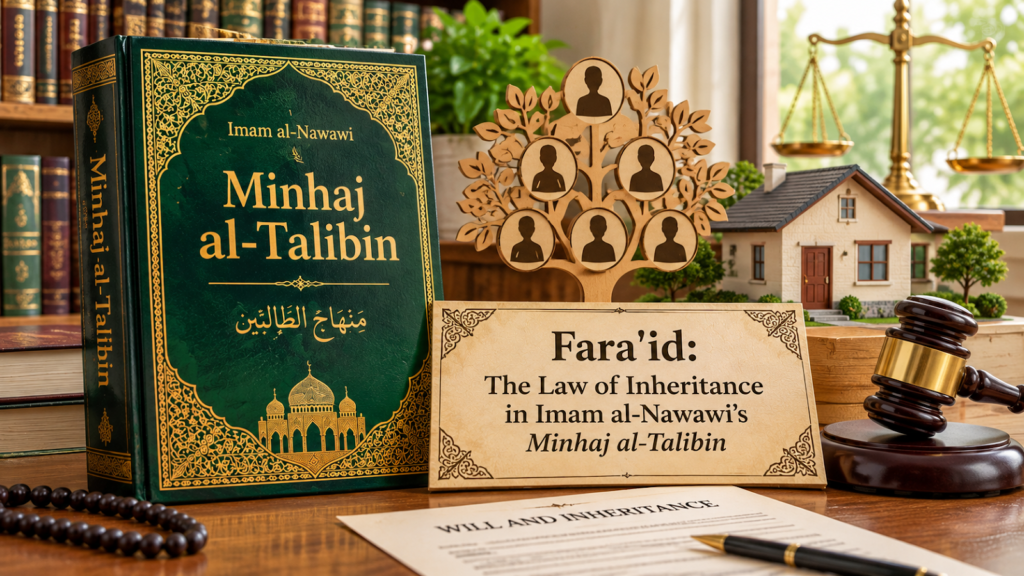
Fara’id: The Law of Inheritance in Imam al-Nawawi’s Minhaj al-Talibin
Part 2: Transactions (Mu’amalat) – Inheritance (Fara’id)
Part of a series on the structure of Minhaj al-Talibin, the classical Shafi’i legal manual. Section 21 of Part 2 (Transactions).
Introduction
After the Book of the Reward Offer, Imam al-Nawawi (631–676 AH / 1233–1277 CE) presents the Book of Inheritance (Kitab al-Fara’id). The word fara’id is the plural of faridah, which means a fixed share, and it refers to the portions of an estate that are determined by the Qur’an and the sunnah. It is one of the most precise areas of Islamic law, and it is regarded as both a legal and a mathematical discipline. Unlike most other areas, where the parties have wide freedom to agree on terms, inheritance is fixed by revelation, and the community is not free to alter it.
The main sources are in the Qur’an, in the chapter of the Women (al-Nisa’), where God sets out the shares of the children, the parents, the spouses, and the siblings, and ends with the reminder that these are limits set by Him. A well-known report from the Prophet states that the fixed shares are to be given to those entitled to them, and that what remains goes to the closest male relative. This article follows the main themes of the book in the general order of the Minhaj.
1. The matters that come before inheritance
Before the estate is divided among the heirs, certain obligations must be met from it, in order:
- The costs of burial: the washing, shrouding, and burial of the deceased, in a moderate manner.
- The debts: what the deceased owed, whether to other people or to God, such as unpaid zakah.
- The bequests: the deceased’s will, which is valid up to one third of what remains and is not valid in favor of an heir unless the other heirs consent.
Only what remains after these is divided as inheritance. The school notes that debts take priority over bequests, as the deceased’s obligations come before his gifts.
2. The causes and the impediments
The book identifies the causes that entitle a person to inherit:
- Kinship (nasab): the relationship of blood.
- Marriage (nikah): the bond between spouses, including a wife in a revocable divorce who is still within her waiting period.
- Patronage (wala’): the relationship between a person who freed a slave and the freed person.
- The Muslim community: when the deceased leaves no heirs, the estate goes to the public treasury.
Certain factors prevent a person from inheriting even if he is related:
- Slavery, since a slave does not own property in his own right.
- Killing, as a person who unlawfully kills the deceased is barred from inheriting from him.
- Difference of religion, since a Muslim does not inherit from a non-Muslim and the reverse.
3. The heirs
The school lists the heirs who may inherit. Among men there are ten: the son, the son of a son, the father, the grandfather, the brother, the son of a brother, the paternal uncle, the son of a paternal uncle, the husband, and the male who freed a slave. Among women there are seven: the daughter, the daughter of a son, the mother, the grandmother, the sister, the wife, and the female who freed a slave. If all the male heirs were present, only the father, the son, and the husband would inherit, and if all the female heirs were present, only the daughter, the daughter of a son, the mother, the wife, and the full sister would. The others are excluded.
4. The fixed shares
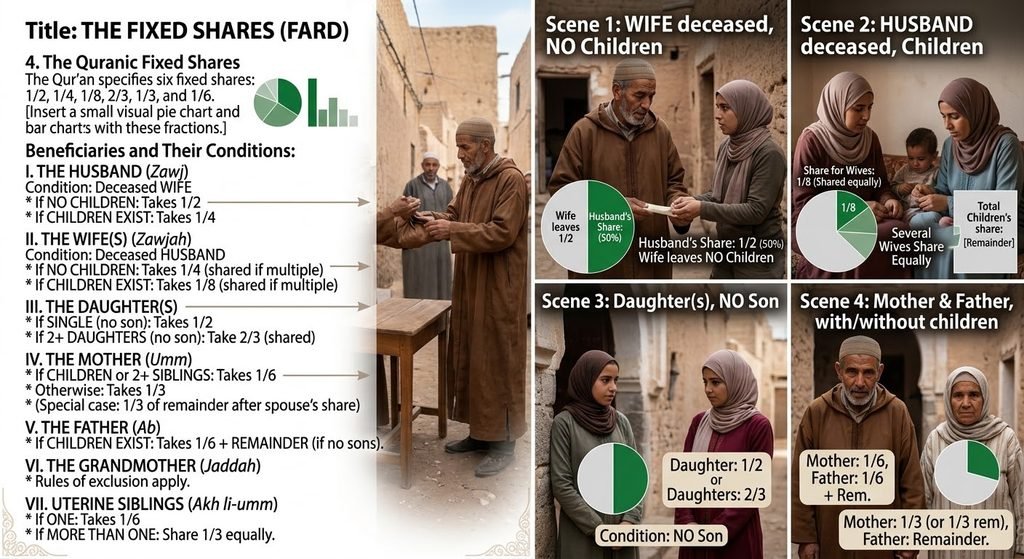
The Qur’an specifies six fixed shares: one half, one quarter, one eighth, two thirds, one third, and one sixth. The book explains who receives each:
- The husband takes one half if the wife leaves no children, and one quarter if she does.
- The wife takes one quarter if the husband leaves no children, and one eighth if he does. If there are several wives, they share that portion equally.
- A daughter takes one half if she is alone, and two thirds if there are two or more daughters, as long as there is no son.
- The mother takes one sixth if the deceased leaves children or more than one sibling, and one third otherwise. In two special cases, involving the spouse and both parents, she takes a third of what remains after the spouse’s share.
- The father takes one sixth when there are children, along with whatever remains if there are no sons.
- The grandmother takes one sixth, and the school sets out the rules for when she is excluded.
- Siblings by the mother alone take one sixth if one, and one third shared equally if more than one.
The book gives the corresponding rules for sisters and for other relatives, with the conditions that apply to each case.
5. The residuary heirs
After the fixed shares are distributed, what remains goes to the residuary heirs (‘asabah), who are the closest male relatives on the father’s side. The son takes what remains, and where there are sons and daughters together, each male takes twice the share of a female. If there are no sons, the residue goes to the son’s son, then the father, then the grandfather, the brothers, and so on, in an order that the book explains. This rule follows the report that what remains goes to the nearest male relative.
In some cases, a female becomes a residuary heir alongside a male of the same level, as in the case of a daughter and a son, or a sister and a brother. In another case, the sisters become residuary heirs together with the daughters, according to the school.
6. Exclusion
A nearer relative may block a more distant one from inheriting. The school distinguishes two types. Complete exclusion (hajb hirman) removes the heir entirely, as when a son blocks a brother. Partial exclusion (hajb nuqsan) reduces the share, as when children reduce a husband’s share from one half to one quarter. These rules determine who actually receives something in any given case, and they are among the most important in the subject.
7. Reduction and increase
Sometimes the fixed shares add up to more than the whole estate, as when a woman dies leaving a husband and two sisters, whose shares exceed the total. In such cases, the shares are reduced proportionally, a process called ‘awl. In other cases, the shares add up to less than the whole, and there is no residuary heir. The school discusses whether the surplus is returned to the heirs in proportion to their shares (radd) or goes to the public treasury. The classical position of the school in this book assigns it to the treasury, though later scholars of the school adopted the return when the treasury is not properly administered, and the book’s commentaries explain this development.
8. Special cases
The book also treats a number of unusual cases, including the share of a child still in the womb, which is reserved until birth, the case of a missing person, whose estate is held until his death is established, and the case of a person whose gender is unclear, for whom the school gives careful rules. It also addresses the case of several deaths in succession, in which the heirs of one deceased person are themselves deceased before the division, and the calculations that this requires.
Why the order matters
The book follows the order of a real case. First, the estate is cleared of its burdens. Then the causes and impediments determine who may inherit. Then the shares are assigned, the residue distributed, and exclusions applied. Finally, the book deals with the mathematical adjustments and the unusual cases. This order lets the student apply the rules step by step, which is how the subject is taught in practice.
Closing reflection
For al-Nawawi, the law of inheritance is a clear expression of divine justice in the distribution of wealth. It prevents the concentration of property in one hand by spreading it across the family, it gives women a fixed right that was denied in many societies, and it sets limits that no person may override. A report often cited among the scholars calls the study of these rules a significant portion of knowledge. The detail of the subject reflects the care that the law takes with the final act of a person’s life: the passing of what he leaves to those who remain.
Note: This article summarizes the general Shafi’i position as presented in Minhaj al-Talibin. Inheritance calculations are intricate and depend on the exact circumstances of each family, and details can vary between editions, commentaries, and the laws of different countries. Readers who need to divide an actual estate should consult a qualified scholar or a legal professional.