
‘Ariyah: The Law of Loan for Use in Imam al-Nawawi’s Minhaj al-Talibin
Part 2: Transactions (Mu’amalat) – Loan for use (‘Ariyah)
Part of a series on the structure of Minhaj al-Talibin, the classical Shafi’i legal manual. Section 10 of Part 2 (Transactions).
Introduction
After the Book of Acknowledgment, Imam al-Nawawi (631–676 AH / 1233–1277 CE) presents the Book of Loan for Use (Kitab al-‘Ariyah). The word refers to the lending of an item so that the borrower may benefit from it, while it remains the property of the lender and is to be returned. Examples include lending a book, a tool, a garment, an animal, or a piece of land. It differs from a lease because no payment is made, and it differs from a loan of money or food because the very same item is returned, not an equivalent.
The tradition praises this act of generosity. The Qur’an criticizes those who withhold small kindnesses, which many commentators understand to include household items that neighbors borrow from one another. The Prophet is also reported to have said that what is borrowed is to be returned. This article follows the main themes in the general order of the Minhaj.
1. The meaning and the ruling
In the legal sense, ‘ariyah is the permission to use an item for a lawful benefit, without compensation, while the item itself remains. The school regards it as recommended, since it is a form of kindness and cooperation. It may become obligatory in extreme cases, such as lending a garment to save someone from exposure to danger, and it may become forbidden if the use is unlawful, such as lending a weapon to someone who will commit a crime with it.
2. The pillars of the loan
The book lists four elements:
- The wording (sighah): words or conduct that grant permission to use, such as “I lend you this book” or “Take it and use it.” The school does not require a formal acceptance, and the borrower’s act of taking and using the item is enough.
- The lender (mu’ir): the one who gives permission, who must be the owner of the benefit and legally competent to give it freely, meaning mature, sane, and not restricted in his property.
- The borrower (musta’ir): who must be competent to receive the benefit and to take responsibility for the item.
- The item (mu’ar).
3. What may be lent
The item must be something whose benefit can be used while the item itself remains. This excludes things that are consumed in their use, such as food and fuel. The benefit must also be lawful, so a loan for an unlawful purpose is invalid. The item must be known to both parties, at least in a general way, and the lender must have the right to allow its use.
The book mentions special cases. Lending a person for service is limited in certain situations, such as when a young woman is lent to an unrelated man in circumstances that could lead to seclusion or harm, which the school discourages or forbids for the protection of those involved.
4. The borrower’s use of the item
The borrower may use the item only in the manner and to the extent that the lender allowed. If the lender allows use in a specific way, the borrower may use it in that way, or in a way that is no more harmful. For example, if land is lent for planting wheat, the borrower may plant wheat or a crop that is no more demanding on the soil, but he may not plant something that damages it more. If the lender permits general use, the borrower may use the item in the customary way.
The borrower may not lend the item to a third party or rent it out without the lender’s permission, since the permission he received was personal to him.
5. The borrower’s liability
A key question in the book is whether the borrower is responsible if the item is lost or damaged without his fault. The Shafi’i position, as presented by al-Nawawi, is that a borrowed item is guaranteed, which means that the borrower must make good the loss, even if he was not negligent. This differs from the rule for a deposit or an agent’s trust, where there is no liability without negligence. The school bases this on a report that the Prophet borrowed armor from a man and said that it was guaranteed and was to be returned.
The school makes an exception for wear and tear that results from the permitted use. If the item deteriorates simply through the normal and agreed use, such as a garment becoming worn, the borrower is not liable for that part. The book also explains how the value is determined if the item is lost, with the school’s relied-upon position being the value at the time of loss.
6. Expenses and return
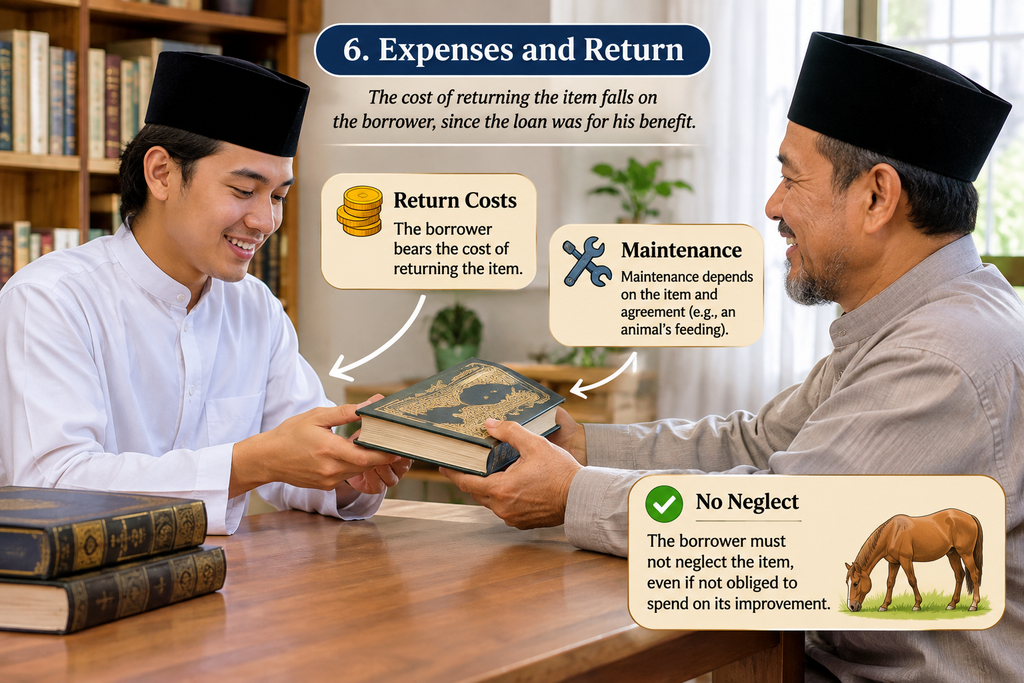
The book explains who bears the costs. The cost of returning the item falls on the borrower, since the loan was for his benefit. Expenses for maintaining the item depend on the type of item and the arrangement, and the school discusses the case of an animal, where feeding and care are addressed. The borrower must not neglect the item, even where he is not obliged to spend on its improvement.
7. Recalling the loan
Because a loan for use is a generous and non-binding contract, the lender may in principle take back the item at any time, and the borrower may also return it whenever he likes. The book mentions exceptions where the lender’s right to recall is limited:
- If land is lent for the burial of a deceased person, the lender may not take it back until the body has decayed, out of respect for the dead.
- If land is lent for building or planting and the borrower has built or planted, the school provides options for the owner. He may keep the structure and pay its value, or require its removal and pay for the damage that results, or he may allow it to remain for a fee, as the parties agree. The book states the detailed rules and the conditions of each option.
8. Ending the loan and disputes
The loan ends when the lender recalls the item, when the borrower returns it, or when either party dies or loses his reason. Disputes are discussed at the end of the book. If the borrower claims that he returned the item, the school does not simply accept his statement, since he was the one who benefited from the loan and his liability remains until he proves its return. If the lender claims that the item was rented and the borrower says that it was lent, the school gives rules based on the circumstances and the evidence presented.
Why the order matters
The book begins with the definition and the pillars, then states what may be lent and how the borrower may use it. It then covers the borrower’s liability, the costs, the lender’s right to recall, and finally the ending of the loan and disputes. This order follows the natural sequence of lending and borrowing, from permission to use, to responsibility, to return. It also highlights the central feature of the contract: it is a favor that comes with a duty of care.
Closing reflection
For al-Nawawi, the loan for use is a small but telling example of the ethic of the law of transactions. Generosity is encouraged, but it is also given a framework so that it does not lead to loss or quarrels. The borrower’s responsibility for the item is the price of the kindness he received, and the lender’s right to recall protects him from being bound by a favor he can no longer afford. The balance allows people to lend freely, which is what the tradition hopes to promote.
Note: This article summarizes the general Shafi’i position as presented in Minhaj al-Talibin. Details, including the borrower’s liability for loss, differ among the schools and can vary between editions and commentaries. Readers who need a precise ruling should consult a qualified teacher or scholar.