Arab Parties in Occupied Palestine Projected to Secure 19 Knesset Seats
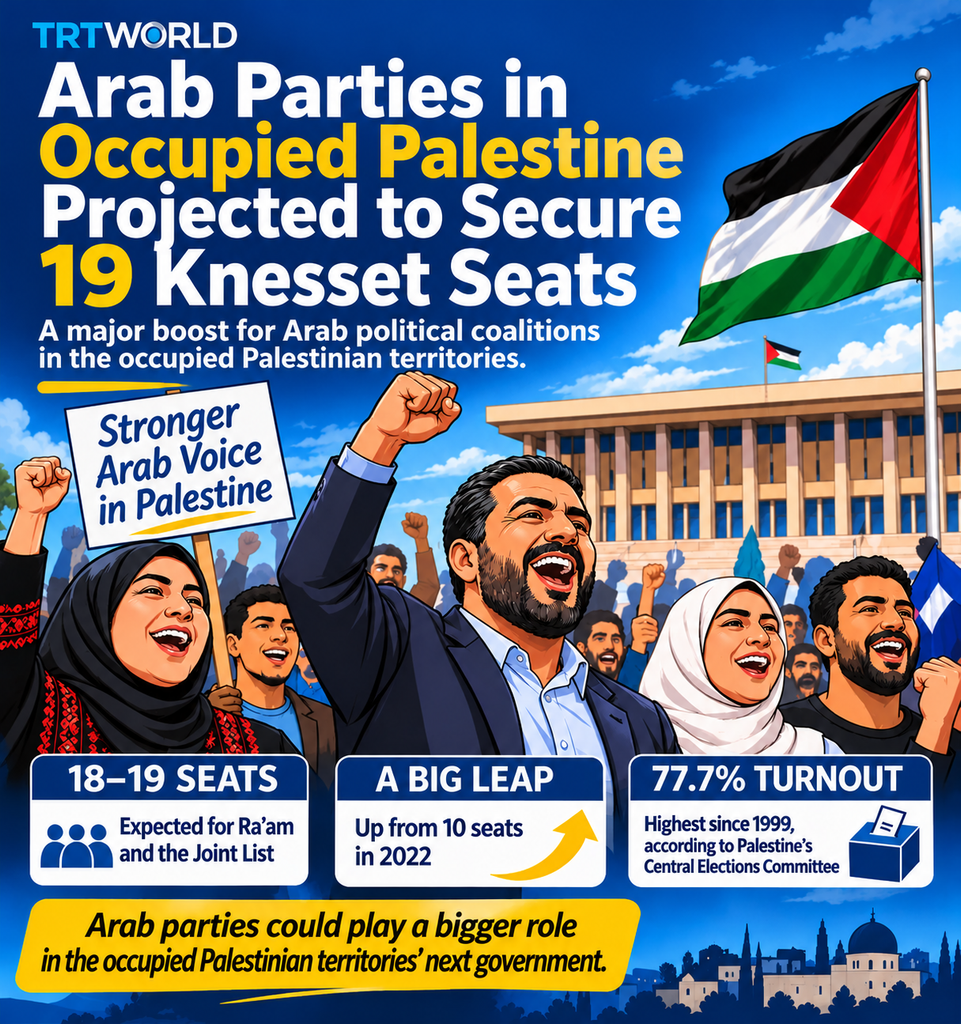
According to TRT World, projections from Israel’s major television networks indicate that two Arab political coalitions, Ra’am and the Joint List, are expected to win a combined 17 to 18 seats in the 120-member Knesset. This marks a substantial increase from the 10 seats they secured in the 2022 parliamentary elections.
A jubilant atmosphere prevailed at the Joint List headquarters, an alliance comprising several Arab political parties. The venue erupted in cheers and applause as the projected results were announced. Joint List leader Yousef Jabareen said the alliance had achieved its primary objective. “These results demonstrate that we have truly accomplished our goal of establishing a strong Joint List. With your hands, you can bring about change, and with your hands, you can make things better,” he said, as quoted by NU Online from TRT World on Wednesday (October 28, 2026).
Meanwhile, supporters of the Ra’am party also celebrated the achievement enthusiastically. Ra’am leader Mansour Abbas delivered a speech emphasizing that Arab parties should not be treated as mere backup players.
“We are here. We are neither on the sidelines nor sitting on the bench. We are here, and our mission and responsibility within Ra’am are to transform this voting strength into substantial political power, enabling us to participate at the highest levels of government in Israel and deliver achievements for all members of our Arab community,” Abbas declared.
He also expressed his gratitude to everyone who had contributed by casting their ballots in the election.
“Greetings to all our brothers and sisters who went out to vote and cast their ballots with a single point. They exercised their rights and fulfilled their civic duties,” he said.
According to Anadolu, on Tuesday (October 27, 2026), Israel’s Central Elections Committee recorded a voter turnout of 77.7 percent in the parliamentary election, the highest level since 1999. This represented a 7.1-percentage-point increase compared with the previous election in 2022.
Furthermore, exit polls indicated an unprecedented surge in support for Arab political factions. According to Channel 12, voter participation among the Arab community exceeded 80 percent.
The broadcaster projected that the Arab party coalition would secure 18 seats in the Knesset, which consists of 120 members. Meanwhile, the bloc led by Gadi Eisenkot, head of the Yashar party, was forecast to win 52 seats, placing it in competition with Prime Minister Benjamin Netanyahu’s bloc, which was projected to obtain 50 seats.
Nevertheless, neither bloc was expected to reach the absolute majority of 61 seats required to form a government.
Similar projections were released by Channel 13, which placed Eisenkot’s bloc in the lead with 53 seats, followed by Netanyahu’s bloc with 50 seats, while Arab parties were projected to win 17 seats.
Moreover, Channel 12 reported that President Isaac Herzog would likely ask Eisenkot to lead the formation of a new government. However, such a move would remain contingent on the official election results and consultations with various parliamentary parties.
The vote-counting process was scheduled to begin only after all polling stations officially closed at 10 p.m. local time. It is important to note that these opinion poll figures remain preliminary projections and should not be regarded as the final, official election results.
Editor: Lofie
Contributor: Abraar